
Introduction
The beverage industry is evolving rapidly as manufacturers respond to changing consumer preferences, increasing demand, and higher expectations for product quality. Producing beverages efficiently requires more than quality ingredients and innovative formulations. It also depends on reliable filling operations, hygienic processing environments, suitable packaging systems, and consistent production controls.
Beverage Filling and Bottling Technology plays an important role in modern beverage manufacturing. Advanced equipment and automated processes help manufacturers improve filling accuracy, maintain product consistency, reduce operational errors, and manage increasing production requirements. From ready-to-drink beverages and iced tea to milkshakes, juices, and flavoured drinks, modern bottling systems support efficient production and dependable packaging.
Understanding these technologies can help beverage manufacturers make informed decisions about production infrastructure and long-term operational improvements.
Understanding the Modern Beverage Bottling Process
The beverage bottling process involves several connected operations that transform prepared beverages into finished, packaged products. Depending on the beverage formulation, production requirements, and packaging material, the process may include bottle preparation, filling, capping, inspection, labelling, coding, and final packing.
Each stage requires appropriate equipment and process controls to maintain product quality. Before filling, bottles must meet the required cleanliness and suitability standards. The filling stage introduces a controlled quantity of beverage into each container. After filling, bottles are sealed to protect the product from external contamination and leakage.
Modern beverage packaging technology also incorporates inspection and coding systems. These processes help manufacturers identify packaging defects, maintain batch information, and prepare finished products for storage and distribution.
How Advanced Beverage Filling Technology Improves Production
Advanced beverage filling technology helps manufacturers achieve greater consistency and operational efficiency. Traditional manual filling methods can involve variations in filling levels, slower processing, and greater dependence on operator handling.
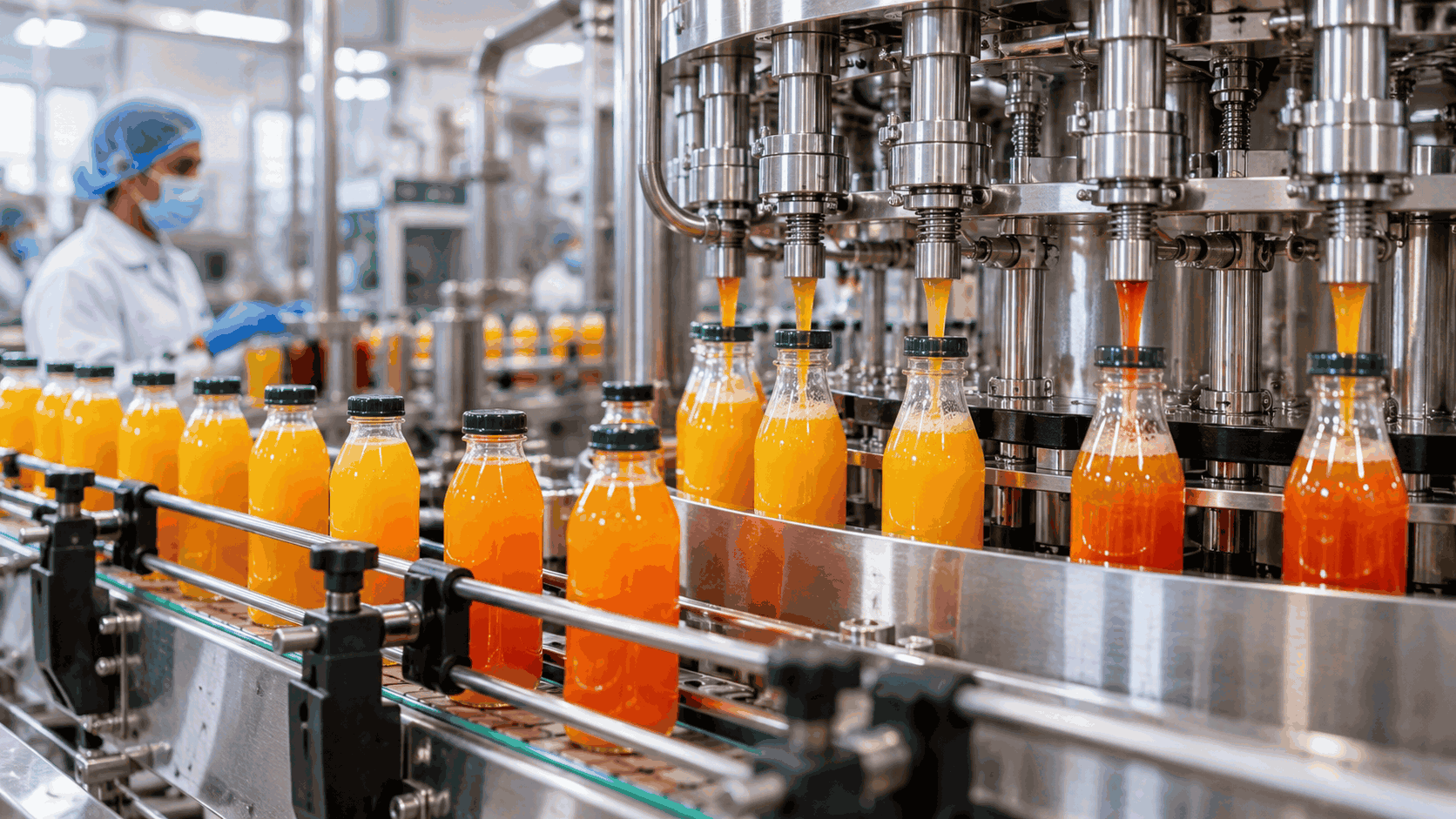
Modern filling systems can automate important production activities, depending on their configuration and application. They may use controlled filling mechanisms, sensors, programmable settings, and integrated conveyor systems to improve process consistency.
Filling accuracy is particularly important because variations in product quantity can affect packaging costs, inventory management, and customer satisfaction. Automated systems help control filling volumes and reduce unnecessary product losses when properly configured and maintained.
Another advantage is production flexibility. Manufacturers can select equipment according to beverage characteristics, bottle dimensions, production capacity, and packaging requirements. This makes modern systems suitable for different beverage categories, although equipment compatibility must always be evaluated before installation.
Automated Beverage Filling Machines and Their Applications
Automated beverage filling machines are designed to manage filling operations with limited manual intervention. Their applications vary depending on the beverage type, container design, and manufacturing scale.
Volumetric filling systems dispense beverages according to predetermined volumes, while other systems use different measurement principles to control filling levels. Gravity-based and pressure-based filling methods may also be selected according to product characteristics.
For carbonated beverages, filling technology must account for carbonation retention and pressure conditions. Non-carbonated beverages, such as iced tea and flavoured drinks, may require different filling configurations.
Industrial beverage filling systems can also be integrated with conveyors, capping equipment, labelling machines, and inspection units. Such integration supports a more organised beverage manufacturing process and helps reduce unnecessary handling between production stages.
The Role of Modern Beverage Production Technology in Quality Control
Production efficiency should never come at the expense of product safety and quality. Modern beverage production technology supports quality management through process monitoring, equipment controls, and documented operating procedures.
Temperature management is important for beverages that require specific processing conditions. Similarly, filling equipment must be cleaned and maintained according to suitable sanitation procedures to minimise contamination risks.
Bottle inspection systems can help identify visible defects, incorrect filling levels, damaged containers, and sealing problems. Batch coding also supports product identification and traceability throughout the supply chain.
Regular equipment maintenance, employee training, and quality inspections are equally important. Technology can improve consistency, but its effectiveness depends on proper operation and established quality management practices. Manufacturers can also explore EXIITO's manufacturing capabilities to understand its broader production and packaging support.
Benefits and Challenges of Advanced Bottling Equipment
Advanced bottling equipment offers several operational benefits. Automated processes can improve production speed, support consistent filling, reduce repetitive manual work, and improve coordination between manufacturing stages.
Integrated packaging systems can also simplify labelling, coding, and final packing operations. For growing beverage manufacturers, selecting scalable equipment can help accommodate increasing production requirements without repeatedly redesigning the entire production process.
However, adopting new technology involves certain challenges. Equipment investment, installation, employee training, maintenance, and technical support must be considered before implementation.
Manufacturers also need to evaluate whether a particular machine is suitable for their beverage formulation and packaging format. Purchasing equipment without understanding product requirements can result in operational difficulties and unnecessary expenditure.
A practical investment decision should consider production capacity, operating costs, hygiene requirements, equipment compatibility, and long-term business objectives.
Future Trends in Beverage Production Automation
The future of beverage production automation is closely connected with smart manufacturing and digital process management. Manufacturers are increasingly exploring technologies that provide better production visibility, equipment monitoring, and operational control.
Sensors and connected monitoring systems can help identify process variations and support preventive maintenance. Digital production records can improve batch documentation and provide useful information for quality investigations.
Energy-efficient equipment, reduced product wastage, and sustainable packaging solutions are also becoming important considerations. Manufacturers are evaluating production systems that use resources more efficiently while maintaining required product standards.
As beverage markets continue to develop, flexible manufacturing systems will become increasingly valuable for businesses managing different formulations, packaging sizes, and product categories.
Conclusion
Beverage Filling and Bottling Technology is an important part of modern beverage manufacturing. From automated filling machines and integrated packaging systems to inspection and digital monitoring, technological improvements can help manufacturers strengthen production efficiency, maintain consistency, and meet changing market requirements.
Choosing suitable equipment requires careful consideration of product characteristics, production capacity, hygiene standards, packaging compatibility, and investment requirements. A well-planned manufacturing process combines appropriate technology with skilled employees and effective quality controls.
For beverage brands looking to expand their production capabilities, understanding these developments is an important step towards building reliable and scalable manufacturing operations.
Looking for a dependable beverage manufacturing partner? EXIITO Beverages offers manufacturing solutions for growing food and beverage brands, including private label, white label, contract manufacturing, third-party manufacturing, OEM, and ODM services.
Explore EXIITO's beverage product range, learn more about contract beverage manufacturing, or discover our manufacturing services.
Ready to discuss your product requirements? Contact EXIITO's team to explore suitable manufacturing opportunities for your brand.