
Introduction
The food manufacturing industry is evolving rapidly as businesses look for better ways to improve production speed, maintain product quality, and meet growing consumer demand. Traditional manufacturing methods are gradually being supported by advanced technologies that make production more organised, accurate, and efficient. Food Manufacturing Automation is becoming an important part of this transformation, helping manufacturers streamline operations while maintaining food safety and consistency.
From automated processing equipment to smart monitoring systems and advanced packaging solutions, modern technology is changing how food products are developed, processed, and delivered. In India, the growing demand for packaged food and beverages is also encouraging manufacturers to explore modern food manufacturing technology and more efficient production methods.
Understanding Food Manufacturing Automation
Food Manufacturing Automation refers to the use of machines, digital systems, sensors, and automated equipment to perform different manufacturing activities with minimal manual intervention. These technologies can support various stages, including raw material handling, mixing, processing, filling, packaging, and quality inspection.
In traditional facilities, many activities depend on manual operations. However, automated food processing plants use integrated systems to improve accuracy, reduce repetitive work, and maintain consistent production standards. Automation can also help manufacturers monitor production parameters and identify operational issues before they affect the finished product.
Key Technologies Transforming Modern Food Manufacturing Plants
Automated Food Processing Equipment
Advanced food processing equipment plays an important role in improving manufacturing operations. Automated mixers, grinders, conveyors, heating systems, and processing machines help manufacturers manage repetitive activities more efficiently.
These systems allow businesses to maintain controlled processing conditions and achieve consistent product characteristics. Depending on the product category, automation can also support accurate ingredient measurement, blending, and processing.
Robotics in Food Processing
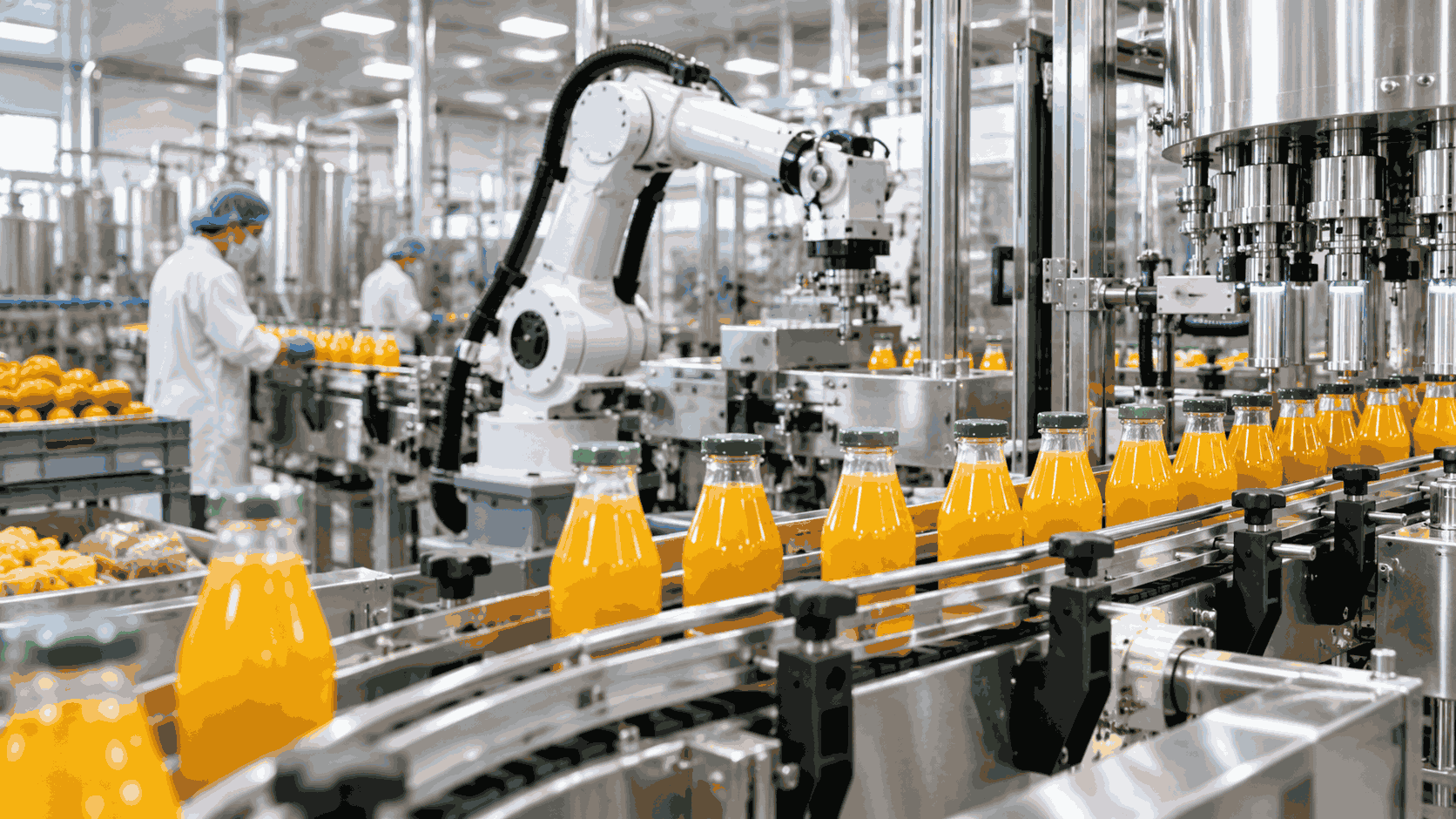
Robotics in food processing is helping manufacturers handle repetitive and physically demanding activities. Industrial robots can support material movement, sorting, product handling, and packaging operations.
Robotic systems can also improve workplace efficiency by reducing unnecessary manual handling. When properly configured and maintained, they help manufacturers achieve greater operational consistency and make better use of available production space.
Automated Production Lines
Automated production lines connect different manufacturing stages into a coordinated workflow. Conveyors, sensors, control panels, and processing equipment work together to move products through designated production stages.
This approach reduces unnecessary movement between operations and helps production teams monitor workflow more effectively. It also supports better production planning when manufacturers need to handle multiple product categories or larger order volumes.
Smart Monitoring and Quality Control
Smart food manufacturing uses digital monitoring systems, sensors, and data collection tools to track important production parameters. Temperature, processing time, equipment performance, and other relevant measurements can be monitored according to product requirements.
These technologies support quality control in food manufacturing by helping teams identify variations and take corrective action when necessary. Digital batch records and traceability systems can also improve documentation and accountability throughout production.
Automated Packaging Systems
Packaging is another important area where industrial automation in food production creates opportunities for improvement. Automated packaging systems can support filling, sealing, labelling, coding, and packing activities.
These machines help maintain packaging accuracy, improve production flow, and reduce repetitive manual work. Properly selected packaging equipment can also support product protection, presentation, and consistency across different production batches.
Benefits of Automation in Food Manufacturing
The adoption of automation in food manufacturing offers several operational advantages. One of the most important benefits is improved food production efficiency. Automated equipment can perform repetitive tasks at controlled speeds, helping manufacturers manage production schedules and reduce unnecessary delays.
Automation can also improve product consistency by maintaining defined processing parameters. This is particularly important for manufacturers producing packaged beverages, snacks, and other food products where taste, texture, appearance, and packaging quality must remain consistent.
Another advantage is better resource utilisation. Automated systems can help manage raw materials, minimise avoidable process variations, and improve equipment utilisation. Digital monitoring can further support maintenance planning by identifying performance issues that require attention.
Additionally, automation can strengthen workplace safety by reducing exposure to certain repetitive or physically demanding tasks. However, trained operators and regular equipment maintenance remain essential for reliable operations.
Challenges and Future of Food Manufacturing Technology
Although automation offers significant opportunities, implementing it requires careful planning. Initial investment in machinery, installation, employee training, and maintenance can be challenging, particularly for small and medium-sized manufacturers.
Businesses must also select equipment according to their product requirements, production capacity, hygiene standards, and available infrastructure. Poorly integrated systems may create operational difficulties instead of improving efficiency.
The future of food manufacturing plants is expected to involve greater use of artificial intelligence, predictive maintenance, robotics, digital traceability, and connected production systems. These developments can help manufacturers make informed operational decisions and respond more effectively to changing market requirements.
For the food manufacturing industry in India, adopting suitable automation technologies can support improved production capabilities and stronger competitiveness as the packaged food market continues to evolve.
How EXIITO Supports Modern Food Manufacturing
At EXIITO Beverages, we understand the importance of organised manufacturing operations, product development, and quality management. Our manufacturing capabilities cover beverages, namkeen, makhana, and pickles, with support for different partner manufacturing requirements.
Our approach focuses on structured production processes, quality checks, product development, and packaging coordination. Businesses interested in launching or expanding their product ranges can explore our manufacturing capabilities and factory infrastructure.
We also focus on quality management through incoming material checks, in-process controls, finished-product inspections, and batch traceability. Learn more about our quality assurance processes and R&D and quality control.
Conclusion
Food Manufacturing Automation is transforming modern food production by improving operational efficiency, supporting consistent quality, and creating opportunities for scalable manufacturing. From robotics and automated processing equipment to smart monitoring and packaging systems, technology is helping manufacturers build more organised and reliable production environments.
As the industry continues to develop, businesses that evaluate and adopt suitable automation solutions will be better positioned to respond to evolving consumer expectations and market demands.
Looking for a reliable food manufacturing partner? Explore EXIITO's contract manufacturing services or contact our team to discuss your food and beverage manufacturing requirements.