
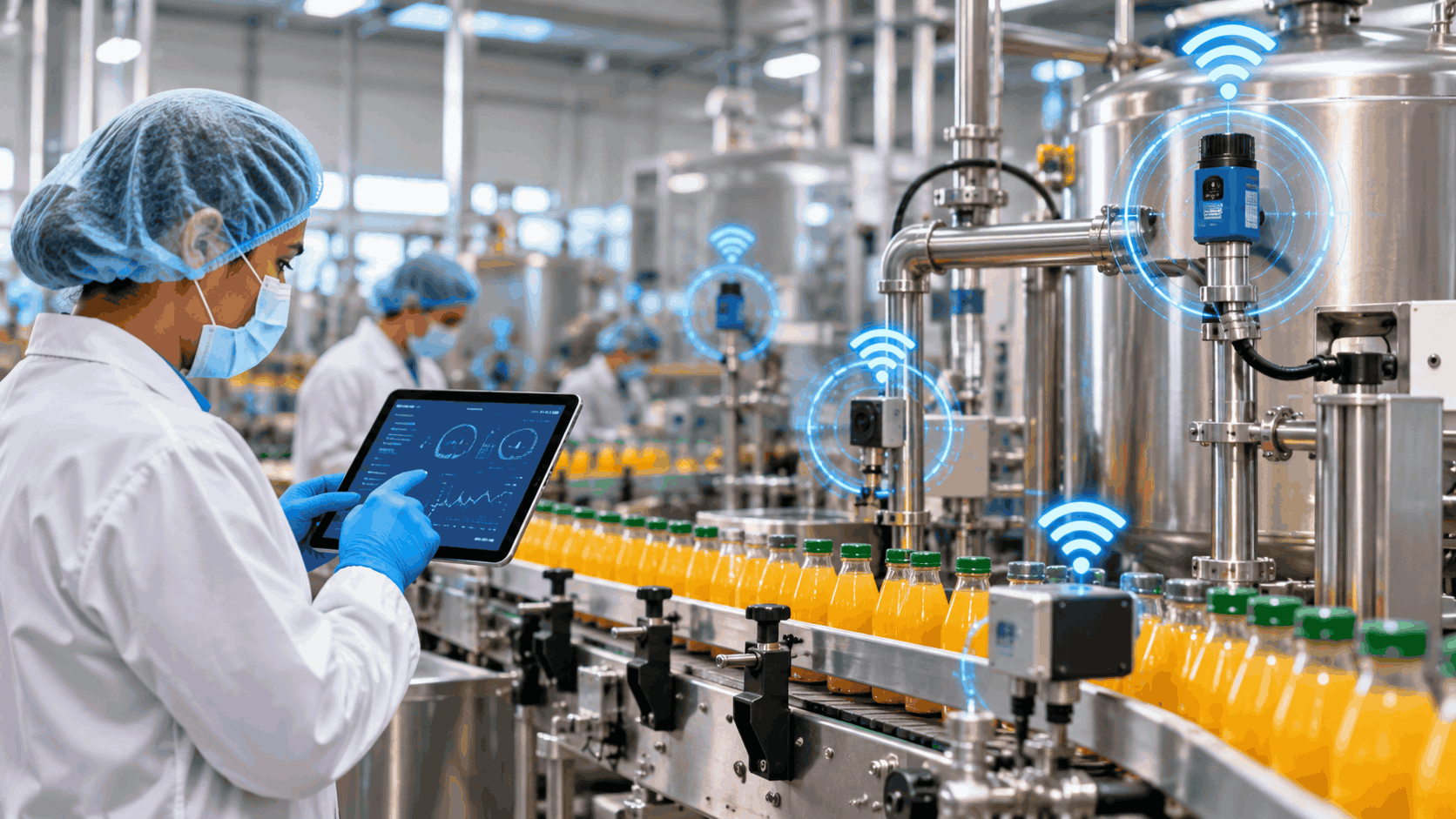
Introduction
Digital transformation is changing how food manufacturers manage production, quality assurance, and equipment maintenance. IoT-enabled sensors provide continuous access to production data, allowing manufacturers to monitor operating conditions, recognize unusual changes, and make informed decisions to improve efficiency and reduce production risks.
The Internet of Things (IoT) connects physical devices, sensors, and software systems so that information can be collected and analysed more effectively. In food manufacturing, these technologies can monitor temperature, humidity, equipment performance, and other important operating conditions. When implemented appropriately, IoT sensors help manufacturers make informed decisions and build more efficient production processes.
Understanding IoT Sensors in Food Manufacturing
IoT sensors collect information from equipment, production lines, storage areas, and other parts of a manufacturing facility. The collected data can be transmitted to connected systems, allowing employees to review operating conditions and identify changes that require attention.
The Internet of Things in Food Industry applications range from monitoring refrigeration units to tracking processing conditions and equipment performance. Instead of relying entirely on manual inspections, manufacturers can use connected devices to access timely information and respond more quickly to deviations.
Smart Food Manufacturing combines connected devices and digital systems to enhance production monitoring, operational coordination, and data-driven decision-making. For additional insights into this technological shift, readers can explore EXIITO's article on how AI and digitalization are transforming the food industry.
Key Applications of IoT Sensors in Food Production
Real-Time Production Monitoring
Real-Time Production Monitoring allows manufacturers to track selected operating conditions while production is underway. Depending on the manufacturing process, sensors can monitor essential parameters such as temperature levels, moisture conditions, system pressure, and the operational status of production equipment.
Monitoring this information helps production teams identify unusual changes and investigate possible causes. For example, temperature sensors can help monitor specified processing conditions, while equipment sensors can indicate when a machine is operating outside its normal parameters.
Timely information can support faster corrective action, reduce avoidable interruptions, and improve production visibility. However, sensors must be properly positioned, calibrated, and maintained to provide reliable readings.
IoT-Based Quality Control and Food Safety
Connected monitoring systems support quality control by continuously assessing production conditions and detecting deviations that could compromise the uniformity and quality of food products. Connected sensors may track processing temperatures, storage environments, and other measurable parameters relevant to a particular product.
Food Safety Monitoring Sensors can also support the monitoring of refrigeration and storage conditions where temperature control is important. Alerts can notify employees when readings move outside established limits, allowing them to investigate and take appropriate action.
Nevertheless, sensor monitoring alone cannot guarantee food safety. Food manufacturers must follow established processing guidelines and maintain strict quality standards throughout production. Readers can explore EXIITO's approach to quality assurance to understand the importance of maintaining product quality and consistency.
Predictive Maintenance in Food Manufacturing
Equipment failures can interrupt food production, increase repair costs, and affect order fulfilment timelines. By analysing machine performance data, manufacturers can recognize early warning signs and resolve potential faults before they cause serious operational issues. Predictive Maintenance in Food Manufacturing enables businesses to analyse equipment data, schedule timely servicing, and prevent unexpected machinery failures that could disrupt production.
Sensors provide valuable insights into machinery condition by recording vibration changes, temperature fluctuations, operating frequency, and energy usage during production. When connected systems detect unusual patterns, maintenance teams can investigate the equipment and determine whether servicing is required.
Identifying equipment issues early helps food manufacturers prevent sudden failures, prolong machinery lifespan, and maintain consistent production with fewer interruptions. Its success depends on reliable data, suitable analytical methods, and appropriate maintenance procedures.
Supporting Food Processing Automation
Food Processing Automation can become more effective when connected sensors provide timely information about production conditions. Sensors may communicate with control systems to support equipment adjustments, maintain specified operating parameters, or trigger alerts when intervention is needed.
Connected Manufacturing Systems can also improve coordination between different production stages by sharing information about equipment status, operating conditions, and process performance. Automated systems should be carefully tested and verified before implementation, especially when their operation can affect food safety, product quality, or compliance with manufacturing specifications.
Benefits of Industrial IoT in Food Processing
Industrial IoT in Food Processing can improve operational visibility by helping manufacturers understand what is happening across their facilities. Ongoing observation of production processes helps businesses spot performance issues, improve workflows, and prevent minor disruptions from growing.
Access to reliable production data can also help teams analyse recurring issues, plan maintenance, and make better-informed decisions. Data-driven insights help food manufacturers optimize resource utilization, streamline production operations, and reduce avoidable material waste.
However, IoT systems require investment in sensors, connectivity, software, maintenance, and employee training. Manufacturers must also consider cybersecurity, data accuracy, compatibility with existing equipment, and the reliability of communication networks. Businesses can support successful implementation by conducting small-scale trials, assessing performance, and progressively integrating effective solutions into wider operations.
The Future of Digital Food Manufacturing
Future developments in food manufacturing are likely to be driven by the integration of connected IoT devices, AI-powered systems, automated equipment, and advanced data analytics. These technologies can work together to identify patterns, improve monitoring, and support more responsive production planning.
For food businesses, successful digital adoption requires more than installing connected devices. Successful implementation depends on accurate information, employee training, clear operational guidelines, and robust quality assurance practices. EXIITO provides further information about its research and development and quality control activities and beverage manufacturing services.
Conclusion
IoT Sensors in Food Manufacturing are helping businesses improve production visibility, monitor important operating conditions, support equipment maintenance, and strengthen selected quality control activities. When integrated carefully, these technologies can contribute to more informed decisions and efficient manufacturing operations.
The key to successful implementation is selecting suitable sensors, maintaining data accuracy, and combining digital monitoring with established food safety and quality procedures.