
Introduction
The food processing industry is continuously evolving as manufacturers seek to improve production efficiency, maintain consistent product quality, and meet increasing customer expectations. Robotics in Food Processing is becoming an important part of this transformation, helping businesses perform repetitive tasks with greater precision, speed, and consistency.
From sorting raw ingredients to handling products and packaging finished goods, robotic systems can support several stages of food production. However, successful implementation requires careful planning, suitable equipment, effective hygiene controls, and trained employees. Understanding the applications, benefits, and challenges of robotics can help food businesses determine where automation may add value to their operations.
Key Applications of Robotics in Food Processing
Sorting, Picking, and Handling Ingredients
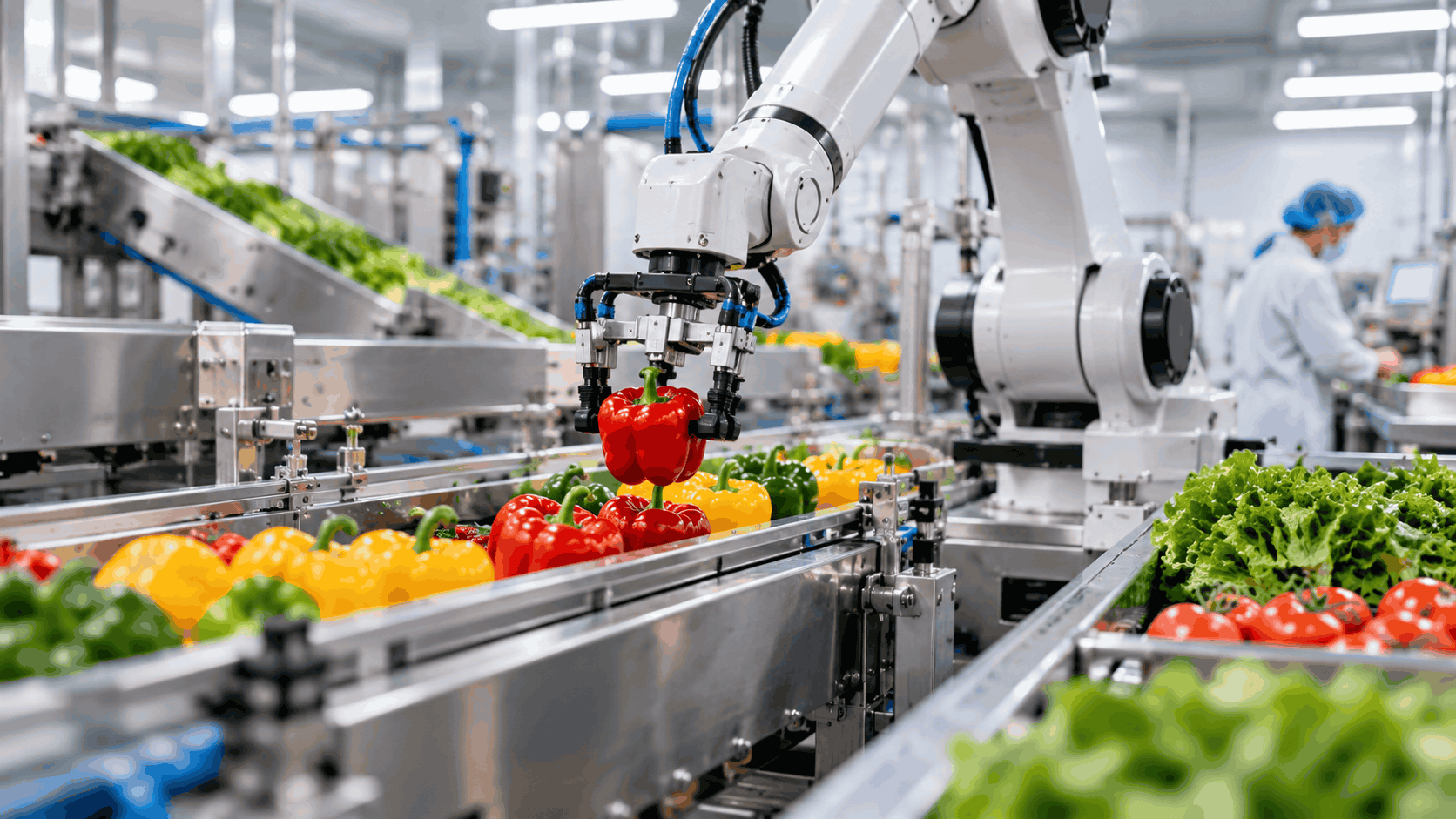
Robots can help manufacturers sort, pick, transfer, and position ingredients during production. Equipped with suitable sensors or vision systems, some robotic solutions can identify products based on visible characteristics such as size, shape, or colour. This can support the separation of certain products and reduce repetitive manual handling.
Industrial Robots in Food Industry applications vary according to the product, production environment, and required level of precision. Robotic arms may handle individual items, while specialised systems can move ingredients between processing stages. Their suitability depends on factors such as product fragility, surface moisture, temperature, and hygiene requirements.
Automated Food Processing Systems
Automated Food Processing Systems can support tasks such as portioning, transferring ingredients, arranging products, and assisting with selected preparation activities. In suitable applications, robots can perform repeated movements consistently, helping manufacturers maintain predictable production workflows.
Food Processing Automation can also connect robotic equipment with conveyors, sensors, and other machinery. When these systems are properly integrated, manufacturers can coordinate different production stages and reduce unnecessary handling. However, food-specific challenges, including irregular shapes, delicate textures, and variations in raw materials, must be considered when selecting equipment.
Robotic Packaging and Sorting
Packaging is one of the important applications of robotics in food manufacturing. Robots can help place products into containers, arrange items in trays, pack cartons, and prepare packaged goods for distribution. Robotic Packaging and Sorting systems can be particularly useful for repetitive, high-volume tasks that require consistent positioning and handling.
Depending on the equipment, automation may also support product grouping and packaging-line coordination. Manufacturers must ensure that packaging operations meet product specifications and that containers, closures, and labels are handled correctly. Businesses exploring beverage production can review EXIITO’s product range to understand its beverage offerings.
Robotic Quality Inspection
Robotic Quality Inspection combines robotic movement with suitable inspection technologies to examine products or packaging. When integrated with cameras and image-processing software, these systems can help identify certain visible defects, incorrect positioning, or packaging irregularities.
Automated inspection can support quality teams by improving consistency in suitable inspection tasks. However, it cannot identify every possible quality or safety issue. Laboratory testing, process monitoring, sanitation procedures, and trained personnel remain essential components of Food Safety and Hygiene. For further information, businesses can explore EXIITO’s quality assurance practices.
Benefits of Robotics in Food Manufacturing
One major advantage of Robotics in Food Manufacturing is the ability to perform repetitive tasks consistently. Robots can help reduce variation in selected operations, support predictable production cycles, and improve the coordination of packaging and material handling. These improvements may contribute to better Food Production Efficiency, depending on the application and how well the system is integrated.
Robotics can also reduce direct human contact with products during certain handling operations. This may help support hygiene objectives when equipment is designed for food environments and cleaned according to established procedures. In addition, automated systems can take on repetitive or physically demanding tasks, allowing employees to focus on supervision, quality checks, maintenance, and problem-solving.
The benefits depend on production volume, equipment capability, maintenance requirements, and operating conditions. Automation should therefore be evaluated against specific business needs rather than adopted simply because the technology is available.
Challenges of Robotics in Food Processing
Despite its advantages, implementing robotics can involve substantial initial investment. Equipment, installation, system integration, employee training, and ongoing maintenance all contribute to the total cost. Smaller manufacturers may need to assess whether the expected operational improvements justify these expenses.
Food processing environments also present technical challenges. Moisture, temperature variations, washdown procedures, and strict hygiene requirements can affect equipment selection and performance. Robots must be suitable for the intended environment and compatible with the cleaning and sanitation procedures required for the production process.
Another consideration is workforce readiness. Employees need appropriate training to operate, monitor, troubleshoot, and maintain robotic systems. Manufacturers must also establish suitable safety procedures and ensure that automated equipment works effectively alongside employees and existing machinery.
The Future of Robotics in Food Manufacturing
The Future of Robotics in Food Manufacturing is likely to involve closer integration between robotics, machine vision, artificial intelligence, and production monitoring systems. These technologies may help suitable applications respond more effectively to product variations, identify equipment issues, and improve coordination across manufacturing lines.
Before investing, businesses should assess their most time-consuming or inconsistent operations, review hygiene and safety requirements, and evaluate the compatibility of new equipment with existing processes. Working with experienced technology providers and conducting practical trials can help determine whether a proposed solution meets production needs.
For food and beverage businesses reviewing their development and manufacturing processes, EXIITO provides information about its research and development and quality control activities and manufacturing services.
Conclusion
Robotics in Food Processing can help manufacturers improve consistency, automate repetitive activities, support packaging operations, and strengthen selected quality inspection processes. However, successful adoption depends on choosing suitable equipment, maintaining food safety and hygiene standards, training employees, and carefully evaluating costs.
As automation technologies continue to develop, food businesses can benefit from identifying practical opportunities where robotics supports their production goals.