
Introduction
Maintaining consistent product quality is one of the most important responsibilities in the food manufacturing industry. As production volumes increase and consumer expectations evolve, manual inspection alone may become difficult to scale across every stage of production. Automated Quality Inspection in Food Production is helping businesses improve inspection consistency, identify visible defects, and make better use of quality-related data.
By combining cameras, sensors, image-processing software, and automated equipment, manufacturers can inspect products and packaging with greater speed and repeatability in suitable applications. These technologies can support existing quality procedures, helping businesses identify potential problems earlier and maintain more consistent production standards.
Understanding Automated Quality Inspection in Food Production
Automated quality inspection uses technology to examine products, ingredients, containers, labels, and packaging against predefined quality criteria. Depending on the system, inspection may involve image analysis, sensor measurements, weight checks, or other specialised testing methods.
Unlike manual inspection, which can be affected by fatigue and differences in human judgement, automated systems can apply consistent inspection rules throughout production. However, their performance depends on proper calibration, suitable operating conditions, and clearly defined acceptance criteria.
Automated Food Quality Control does not eliminate the need for trained quality professionals. Instead, it can help them review inspection results, investigate irregularities, and make informed decisions about corrective actions.
Key Technologies Transforming Food Quality Inspection
AI-Powered Quality Inspection and Machine Vision
AI-Powered Quality Inspection uses artificial intelligence to analyse inspection data and identify patterns associated with potential defects. In suitable applications, machine learning models can be trained to recognise product characteristics and distinguish acceptable items from those requiring further review.
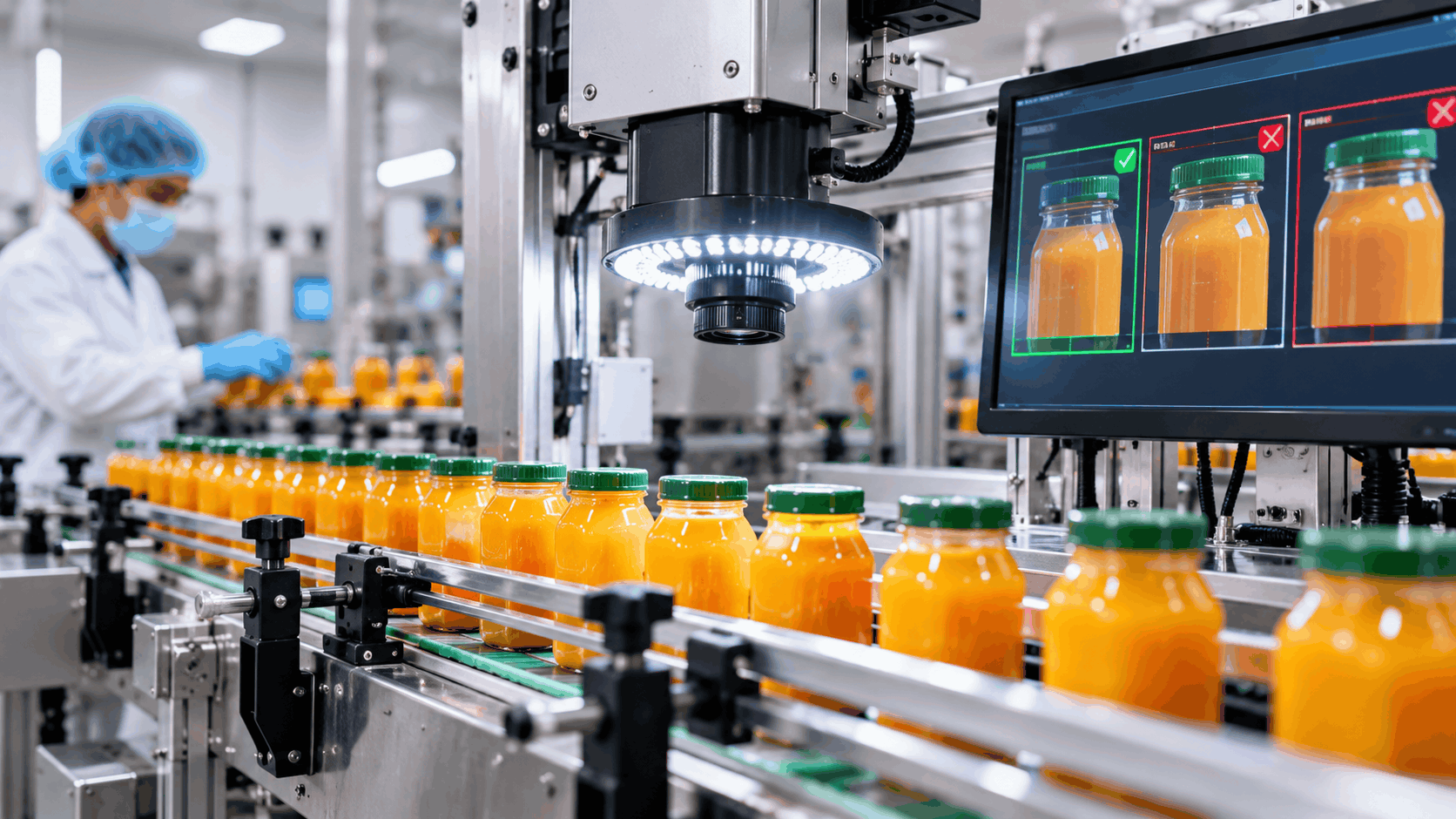
Machine Vision in Food Processing uses cameras and image-processing systems to examine visible features such as colour, shape, size, surface condition, and packaging alignment. For example, a vision system may identify damaged packaging, missing labels, or visible inconsistencies in a product.
These technologies can improve inspection speed and repeatability when configured for the specific product and production environment. However, AI systems require appropriate training data, validation, and ongoing monitoring to maintain reliable performance.
Automated Defect Detection and Real-Time Monitoring
Automated Defect Detection helps identify products that do not meet defined visual or measurable standards. Depending on the application, systems may detect packaging damage, incorrect positioning, inconsistent dimensions, or other specified defects before products move to the next production stage.
Real-Time Quality Monitoring allows manufacturers to review inspection results as production progresses. When a system identifies an unusual pattern, it can alert operators so they can investigate the cause and take appropriate action.
Early detection may help reduce unnecessary rework and prevent repeated production errors. Nevertheless, inspection systems must be configured to minimise both missed defects and false rejections, and their results should be reviewed according to established quality procedures.
Benefits of Automated Food Quality Inspection
Improving Consistency and Production Efficiency
Food Quality Inspection Systems can inspect products at a consistent pace and apply predefined criteria repeatedly. This can be valuable in high-volume operations where manual checks alone may struggle to keep up with production speed.
When integrated effectively, automated inspection can support Food Production Automation by reducing repetitive checking tasks and helping employees focus on exception handling, process improvement, and quality decisions. It may also generate records that help teams identify recurring issues and assess production performance.
Supporting Food Safety and Quality Assurance
Food Safety and Quality Assurance involves more than identifying visible defects. It also requires appropriate hygiene practices, validated processes, ingredient checks, testing, documentation, and effective control measures.
Automated inspection can contribute to this broader system by identifying certain packaging or product irregularities. However, visual inspection cannot independently confirm microbiological safety, detect every chemical hazard, or replace required laboratory testing. Manufacturers must select technologies that match their actual risks and quality requirements.
Businesses can learn more about EXIITO’s approach through its quality assurance practices and research and development and quality control activities.
Challenges and Future Trends
Despite its advantages, implementing automated inspection can require significant investment in equipment, software, installation, staff training, and maintenance. Different products may also require different inspection settings, especially when natural variations in colour, shape, texture, or packaging are common.
Manufacturers must consider system accuracy, integration with existing production lines, data management, and the consequences of incorrect inspection decisions. Regular calibration, validation, cleaning, and performance reviews are essential to ensure that systems continue to meet their intended requirements.
The future of Food Manufacturing Technology is likely to include greater integration between machine vision, artificial intelligence, connected sensors, and digital production records. These developments may support more detailed analysis and faster identification of recurring quality issues. However, technology should be adopted based on verified performance, operational needs, and food safety requirements rather than novelty alone.
Conclusion
Automated Quality Inspection in Food Production is changing how manufacturers monitor product consistency, identify defects, and manage inspection data. By combining suitable inspection technologies with trained personnel and established quality procedures, businesses can improve inspection efficiency and strengthen their approach to quality management.
Successful implementation requires careful system selection, reliable validation, regular monitoring, and a clear understanding of what each technology can and cannot detect.