
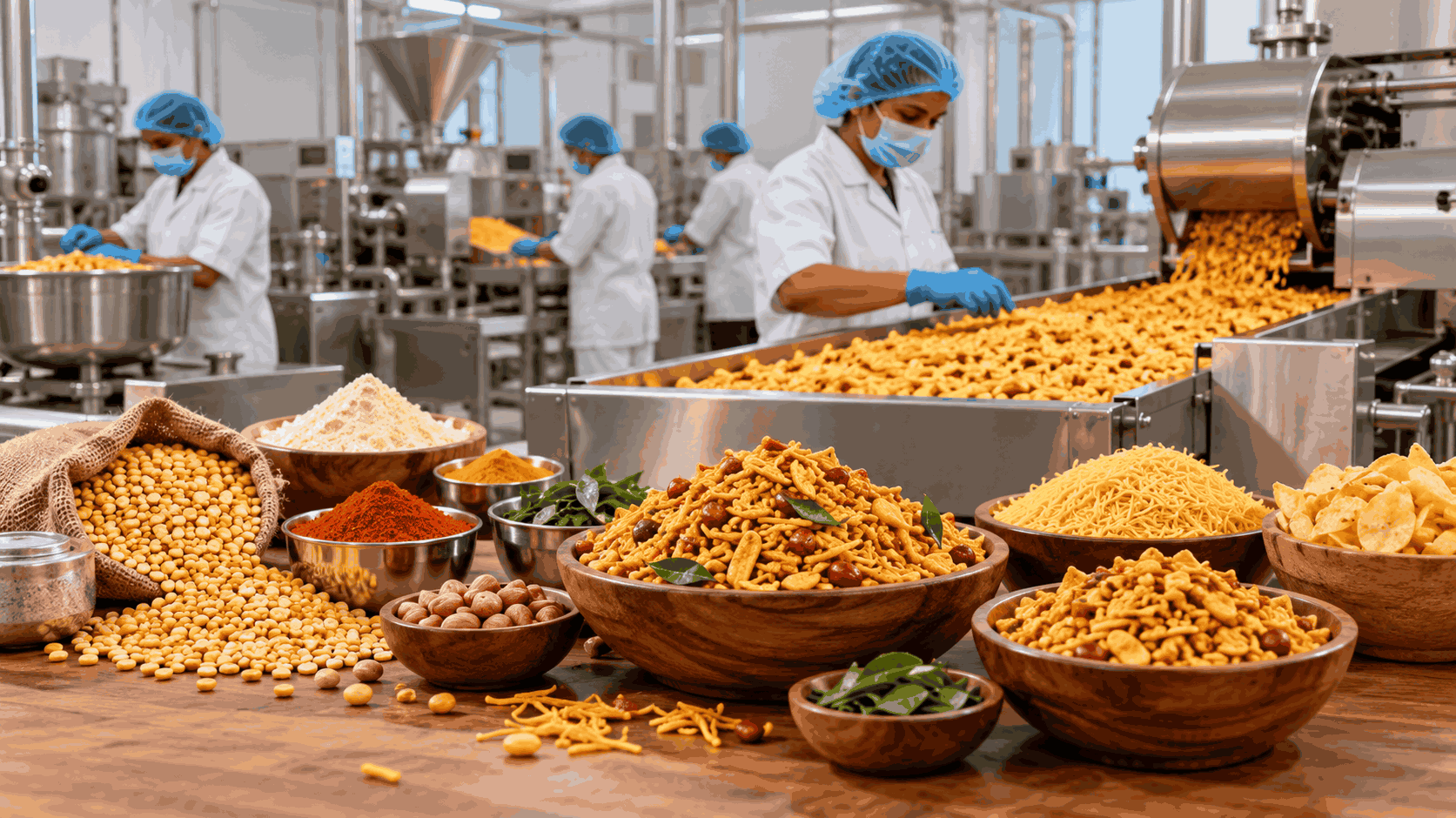
Introduction
Namkeen is an important part of India's packaged snack market, with products ranging from sev and bhujia to mixtures, gathiya, and other savoury snacks. As consumer demand for convenient and ready-to-eat snacks continues to evolve, food businesses are exploring opportunities in Commercial Namkeen Manufacturing to develop products for retail markets, distributors, and private-label brands.
However, producing namkeen on a commercial scale requires more than preparing a traditional recipe in larger quantities. Manufacturers must manage ingredient quality, processing conditions, product consistency, hygiene, and packaging. Understanding each stage helps businesses establish an organised and reliable Namkeen Manufacturing Process.
Selecting Quality Namkeen Ingredients
The first stage of namkeen production is selecting suitable raw materials. Common Namkeen Ingredients include gram flour, pulses, edible oils, spices, salt, flour, peanuts, and other ingredients depending on the product variety.
Ingredient selection directly influences the taste, texture, appearance, and overall quality of the finished snack. Manufacturers should evaluate supplier reliability, ingredient specifications, freshness, and consistency before purchasing materials in bulk.
Incoming raw materials should be inspected and stored under appropriate conditions to protect them from moisture, contamination, and quality deterioration. Establishing clear purchasing specifications helps maintain consistency across production batches.
Ingredient Preparation and Mixing
After raw materials are approved, they move to the preparation stage. Ingredients may require cleaning, sieving, sorting, or weighing according to the product formulation.
The Namkeen Making Process involves preparing a suitable mixture or dough based on the desired snack type. For products such as sev and bhujia, gram flour and selected seasonings are combined with other ingredients and controlled quantities of water to achieve the required consistency.
Accurate weighing and mixing are important because variations in ingredient proportions can affect texture, flavour, and processing performance. Standardised formulations help manufacturers reproduce the same product characteristics across different batches.
Processing, Shaping, and Cooking
Processing methods depend on the type of namkeen being manufactured. In sev and bhujia production, prepared dough may pass through specialised extruders or forming equipment to create the desired shapes and thickness.
For fried snacks, the shaped product is cooked in edible oil under controlled conditions. Temperature, cooking duration, and product thickness influence colour, crispness, moisture content, and oil absorption. Other snack varieties may use roasting, baking, or alternative processing methods.
A properly planned Namkeen Production Process helps manufacturers maintain consistent output while managing product quality. Processing conditions should be established through suitable trials and monitored during production.
Commercial Namkeen Manufacturing Machinery
Suitable machinery plays an important role in increasing production capacity and maintaining consistency. Depending on the product range and facility requirements, Namkeen Manufacturing Machinery may include dough mixers, sieving equipment, extruders, fryers, oil filtration systems, seasoning machines, cooling conveyors, and packaging machines.
For Industrial Namkeen Production, equipment selection should consider batch size, production speed, product characteristics, available space, hygiene requirements, and maintenance support.
Integrating equipment across different stages can improve workflow and reduce unnecessary manual handling. However, machinery should be selected according to actual production needs rather than capacity alone. A mismatch between processing and packaging speeds can create bottlenecks and affect overall output.
Seasoning, Cooling, and Namkeen Quality Control
After cooking, namkeen products generally require suitable cooling before seasoning and packaging. Cooling helps prepare the product for subsequent handling and can reduce the risk of moisture-related quality issues when managed correctly.
Seasoning is then applied according to the approved formulation. Consistent distribution is important because uneven seasoning can create variations in taste between portions of the same batch.
Namkeen Quality Control should take place throughout production. Manufacturers may monitor product appearance, texture, flavour, moisture, seasoning distribution, and other relevant specifications. For fried products, oil quality and frying conditions also require attention.
Quality checks should include incoming ingredients, processing stages, and finished products. EXIITO explains its approach through its Quality Assurance system, while its R&D and Quality Control services cover product development, sampling, and process trials.
Namkeen Packaging and Storage
Packaging is an important final stage in Packaged Namkeen Manufacturing because it helps protect the product during storage, transportation, and retail distribution.
The Namkeen Packaging Process generally involves transferring the cooled product into suitable pouches or containers, filling the required quantity, sealing the pack, applying labels, and checking the finished packaging.
Packaging materials should provide suitable protection against moisture, air, and external contamination. The selected packaging format should also support the product's expected shelf life and distribution conditions.
Before commercial launch, manufacturers should evaluate packaging compatibility, seal integrity, storage requirements, and applicable labelling regulations. Properly managed packaging helps preserve product characteristics and improve presentation.
Challenges and Future Trends in Commercial Namkeen Production
Businesses involved in Commercial Namkeen Production may face challenges such as fluctuating raw material prices, maintaining consistent flavour, controlling oil quality, reducing production waste, and managing packaging costs.
The industry is also seeing growing interest in new flavours, regional snack varieties, convenient pack formats, and products designed for different consumer preferences. Manufacturers may explore improved processing equipment, better oil management, and more efficient packaging systems to support these developments.
Careful product planning, consistent quality procedures, and regular process evaluation can help businesses respond to market requirements while maintaining reliable production operations.
Conclusion
Successful Commercial Namkeen Manufacturing depends on managing every stage, from raw material selection and preparation to processing, seasoning, quality control, and packaging. Each step contributes to the taste, texture, safety, and consistency of the finished snack.
For businesses planning to introduce or expand a namkeen product range, choosing suitable manufacturing support and establishing clear product specifications are important starting points.
Planning to develop your own food or snack brand? Explore EXIITO's manufacturing services to understand its manufacturing and product-development support. You can also contact the EXIITO team to discuss your product concept, specifications, and manufacturing requirements.