
Introduction
Pickles are popular food products valued for their distinctive taste, texture, aroma, and variety of flavours. From traditional mango and lime pickles to mixed vegetable varieties, maintaining consistent quality is essential for building customer trust and developing a successful packaged food brand. This requires careful attention to ingredients, preparation, processing, hygiene, and packaging.
A well-managed Pickle Manufacturing Process helps manufacturers maintain product characteristics across batches while supporting food safety and suitable storage conditions. For commercial manufacturers, standardising each production stage is important for delivering products that meet defined quality expectations.
Selecting Quality Pickle Ingredients
The foundation of good pickle production is selecting suitable raw materials. Common Pickle Ingredients include fresh fruits or vegetables, edible oils, salt, spices, vinegar, and other permitted ingredients, depending on the recipe and processing method.
Raw materials should be evaluated for freshness, maturity, appearance, and suitability for processing. Damaged, spoiled, or contaminated produce can affect the quality and safety of the finished product. Suppliers should be selected based on their ability to provide consistent materials that meet agreed specifications.
Incoming ingredients should be inspected, cleaned, and stored under appropriate conditions. Consistent ingredient quality helps manufacturers maintain the expected flavour, colour, texture, and overall product profile.
Pickle Preparation and Processing Methods
The Pickle Preparation Process begins with sorting, washing, and preparing the selected fruits or vegetables. Depending on the recipe, ingredients may be peeled, cut, deseeded, or divided into specific sizes to achieve uniformity.
The prepared ingredients are then combined with the required salt, spices, oil, vinegar, or other formulation components. Accurate measurement is important because ingredient proportions influence taste, acidity, texture, and product stability.
Different Pickle Processing Methods are used depending on the product category. Some pickles are prepared through oil-based methods, while others rely on vinegar or controlled fermentation. The selected method should match the recipe, desired sensory characteristics, and intended storage conditions.
Understanding the Pickle Fermentation Process
The Pickle Fermentation Process is used for certain products in which beneficial microorganisms convert naturally occurring sugars into organic acids. In vegetable fermentation, lactic acid bacteria can produce lactic acid, which contributes to the characteristic sour flavour and helps create an acidic environment.
Successful fermentation depends on suitable raw materials, salt concentration, temperature, hygiene, and processing time. These conditions should be monitored because uncontrolled fermentation can affect flavour, texture, and product safety.
Not every pickle is fermented. Vinegar-based and oil-based products may follow different preparation and preservation approaches. Manufacturers should select and validate the appropriate process for each formulation rather than applying the same conditions to every pickle variety.
Commercial Pickle Production and Quality Control
In Commercial Pickle Production, maintaining consistency becomes more challenging as batch sizes increase. A recipe that performs well in small quantities may require adjustments when production is scaled up.
Manufacturers should establish standard formulations, ingredient specifications, preparation procedures, and controlled processing conditions. These practices help reduce variations in taste, colour, texture, and acidity between batches.
Pickle Quality Control should cover raw materials, preparation, processing, and finished products. Depending on the product, important checks may include pH, acidity, salt concentration, appearance, aroma, texture, and packaging integrity. Testing procedures should be appropriate for the formulation and supported by documented quality records.
EXIITO describes its approach to quality management through its Quality Assurance system. Its R&D and Quality Control services also explain product development, sampling, sensory evaluation, and process trials.
Industrial Pickle Manufacturing and Process Management
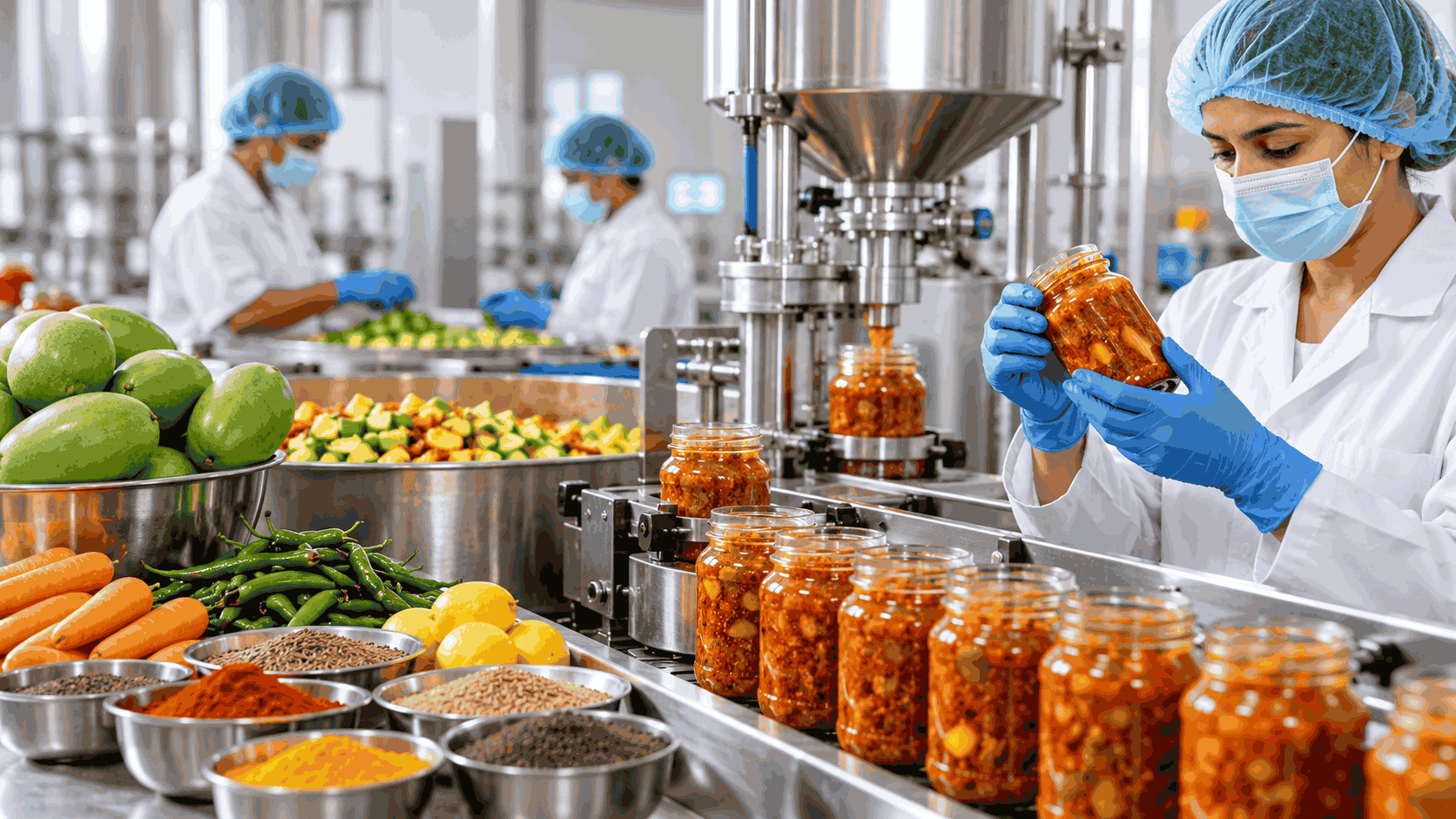
Industrial Pickle Manufacturing requires suitable equipment, trained personnel, and clearly defined operating procedures. Depending on the product and production scale, equipment may include washing units, cutting machines, mixing tanks, weighing systems, and filling equipment.
Manufacturers should ensure that equipment is suitable for the ingredients and processing conditions. Hygienic handling, regular cleaning, equipment maintenance, and appropriate employee training help reduce contamination risks and production inconsistencies.
Monitoring production conditions also helps identify problems early. Maintaining batch records and traceability information supports investigations when a product does not meet its approved specifications.
Pickle Packaging Process and Shelf Life
The Pickle Packaging Process plays an important role in protecting finished products during storage and transportation. Depending on the formulation, pickles may be packed in glass jars, food-grade plastic containers, or other suitable packaging formats.
Containers and closures should be compatible with the product, particularly when it contains acidic ingredients, oil, or spices. Proper filling, sealing, labelling, and packaging inspections help protect the product from leakage and external contamination.
Pickle Shelf Life depends on several factors, including formulation, acidity, processing conditions, hygiene, packaging integrity, and storage temperature. Manufacturers should establish shelf-life claims through appropriate testing and validation rather than relying on assumptions. Labels should also communicate accurate storage instructions and comply with applicable food regulations.
Challenges and Future Trends in Pickle Manufacturing
Manufacturers may face challenges such as seasonal ingredient availability, variations in raw material quality, changing input costs, and maintaining consistent flavour across large batches. Packaging selection and shelf-life validation can also require careful evaluation.
The industry continues to explore new flavour combinations, convenient packaging formats, improved process monitoring, and more efficient production methods. Businesses that combine traditional recipes with standardised manufacturing practices can respond to market requirements while maintaining product identity.
Conclusion
A reliable Pickle Manufacturing Process depends on every stage, from ingredient selection and preparation to fermentation or acidification, quality control, and packaging. Consistent procedures, suitable equipment, trained employees, and validated storage conditions help manufacturers maintain product quality and build customer confidence.
Planning to develop your own food product or packaged food brand? Explore EXIITO's manufacturing services to learn about its product development and manufacturing support. You can also contact the EXIITO team to discuss your product concept and manufacturing requirements.