
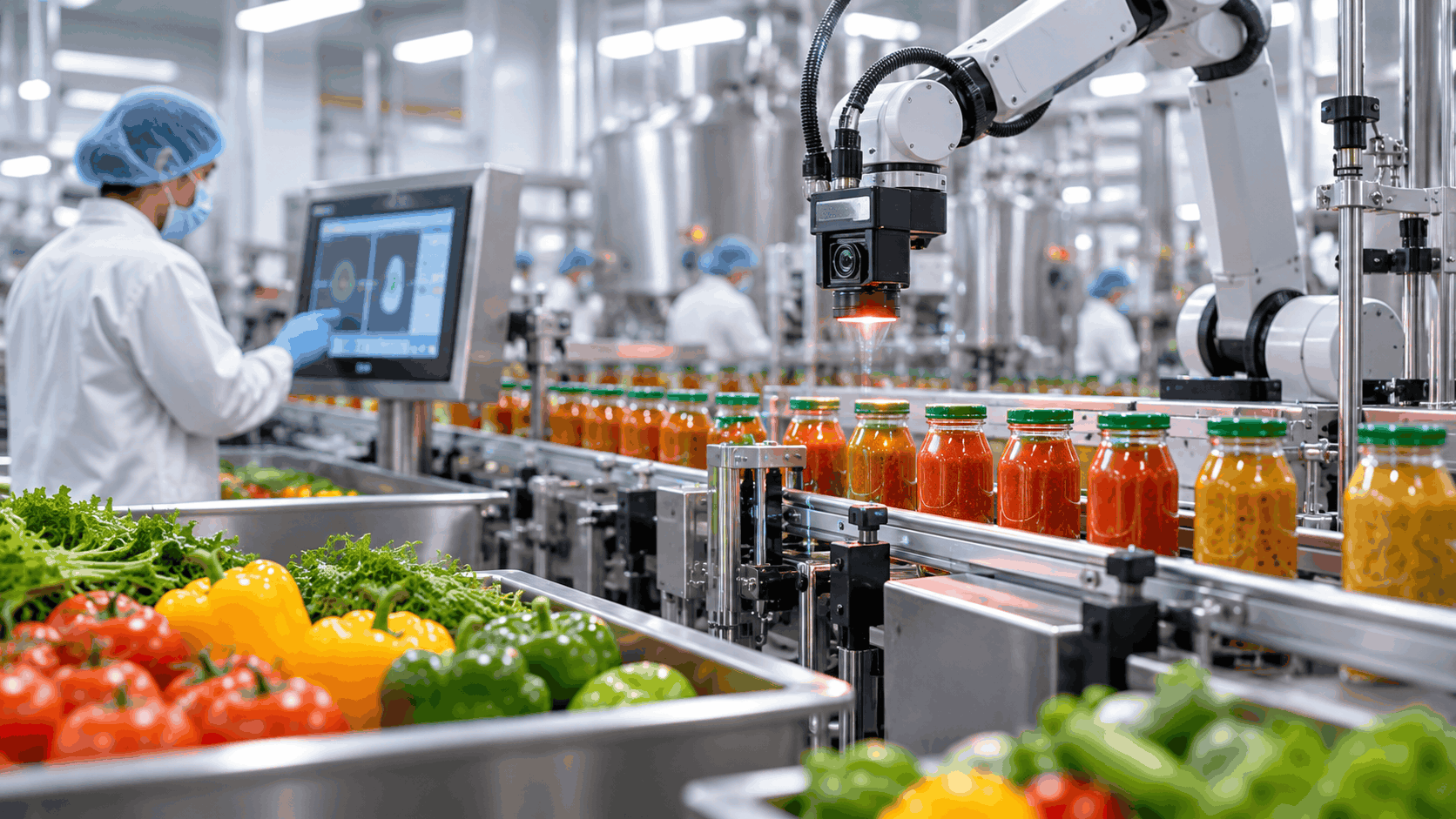
Introduction
The food manufacturing industry is evolving as businesses look for better ways to improve efficiency, maintain product quality, reduce waste, and respond to changing consumer expectations. Artificial Intelligence in Food Manufacturing is becoming an important part of this transformation by helping businesses analyse production data, identify patterns, and make more informed operational decisions.
From monitoring product quality to forecasting demand, artificial intelligence (AI) offers practical applications across several stages of food production. When combined with skilled employees, reliable data, and established quality procedures, AI can help manufacturers improve consistency and build more efficient operations.
Understanding Artificial Intelligence in Food Manufacturing
Artificial Intelligence in Food Manufacturing refers to the use of computer systems that analyse data, recognise patterns, and support decisions related to production, quality, inventory, and equipment performance. These systems can process information from production records, sensors, cameras, and other digital tools to identify trends that may be difficult to detect manually.
Unlike traditional processes that depend mainly on fixed rules and manual observations, AI-based systems can help manufacturers evaluate changing conditions and identify opportunities for improvement. However, their effectiveness depends on data quality, suitable implementation, and human oversight.
As businesses explore digital transformation in the food industry, AI is becoming one of several technologies that can support more informed and responsive manufacturing decisions.
Key Applications of AI in Food Manufacturing
Food Manufacturing Automation and Process Optimization
Food Manufacturing Automation uses technology to perform or control repetitive production activities, helping businesses improve operational consistency. When AI is integrated into suitable automated systems, it can analyse production data, identify variations, and support adjustments to improve efficiency.
AI-Driven Process Optimization can help manufacturers examine factors such as processing time, ingredient quantities, temperature readings, and production output. Analysing these variables may reveal opportunities to reduce unnecessary resource use, improve batch consistency, and identify process bottlenecks.
However, AI recommendations should be validated before being applied to production. Food manufacturers must ensure that any process changes remain within approved product specifications and established food safety requirements.
AI-Powered Quality Control and Food Safety
Maintaining consistent quality is essential in food manufacturing. AI-Powered Quality Control can use computer vision and image analysis to inspect visible product characteristics, identify packaging defects, and detect certain inconsistencies more quickly than manual inspection alone.
For example, suitable vision systems may help identify irregular product shapes, damaged packaging, incorrect labels, or visible surface defects. Other data analysis tools can support the review of production records and help identify patterns that require further investigation.
AI does not replace comprehensive Food Safety and Quality Control procedures. Laboratory testing, sanitation practices, validated processes, and trained quality personnel remain important. Manufacturers should integrate AI tools into their established systems rather than treating them as a substitute for food safety controls. Businesses can learn more about the importance of these practices through EXIITO’s quality assurance approach.
Predictive Maintenance in Food Processing
Equipment breakdowns can interrupt production schedules, delay deliveries, and increase maintenance costs. Predictive Maintenance in Food Processing uses equipment data, sensor readings, and performance patterns to estimate when machinery may require attention.
AI-supported maintenance systems can analyse changes in vibration, temperature, operating cycles, or energy consumption to flag unusual behaviour. Maintenance teams can then investigate potential problems before they develop into major failures, where reliable data and suitable models make early detection possible.
The benefits depend on the quality of monitoring systems and the type of equipment involved. Regular inspections and preventive maintenance remain necessary, but predictive insights can help manufacturers plan maintenance more effectively.
Machine Learning and Food Product Development
Machine Learning in Food Industry applications can help businesses analyse production results, customer feedback, ingredient characteristics, and product performance. These insights may support decisions about formulations, demand patterns, and opportunities to improve existing products.
AI in Food Product Development can assist research teams in comparing formulation options, identifying relationships between ingredients, and organising experimental results. For instance, data analysis may help a development team understand how ingredient proportions influence selected product characteristics.
Nevertheless, AI-generated suggestions require practical testing. Sensory evaluation, stability studies, ingredient compatibility checks, and appropriate quality assessments are essential before a product is approved for commercial production. EXIITO’s research and development and quality control page provides further information about these areas of food and beverage development.
Benefits and Challenges of Smart Food Manufacturing
Smart Food Manufacturing can help businesses improve visibility across production, identify inefficiencies, support more consistent inspections, and make better use of operational data. AI-supported forecasting may also help manufacturers plan raw material requirements and production schedules more effectively, potentially reducing avoidable waste and shortages.
Despite these advantages, implementation can involve significant initial investment, data integration challenges, employee training requirements, and cybersecurity considerations. Inaccurate or incomplete data can also produce unreliable recommendations. Manufacturers should therefore identify a clear business need, assess the quality of available data, and test solutions on a manageable scale before expanding their use.
The wider Digital Transformation in Food Manufacturing will depend not only on technology but also on effective processes, employee expertise, and responsible decision-making. Human supervision remains essential when decisions affect food safety, product specifications, or consumer wellbeing.
Conclusion
Artificial Intelligence in Food Manufacturing is creating new opportunities to improve production planning, quality inspection, equipment maintenance, and product development. When implemented carefully, AI can help manufacturers make data-informed decisions, improve operational efficiency, and respond more effectively to changing business needs.
Successful adoption requires reliable data, suitable technology, trained employees, and strong quality controls. By combining these foundations with continuous improvement, food manufacturers can explore AI while maintaining product consistency and safety.