
Introduction
Have you ever wondered how a beverage goes from a simple combination of ingredients to a finished bottle ready for store shelves? The process involves much more than mixing liquids and filling containers. Beverage manufacturing requires careful planning, ingredient selection, product formulation, processing, quality checks, and suitable packaging.
A well-managed Beverage Manufacturing Process helps manufacturers develop products that meet defined taste, appearance, safety, and quality requirements. Whether producing iced tea, fruit-based drinks, coffee, or traditional beverages, each manufacturing stage plays an important role in creating a consistent finished product.
Understanding the Beverage Manufacturing Process
The Beverage Production Process begins with understanding the product concept and its intended consumers. Manufacturers consider the beverage category, flavour profile, ingredients, packaging format, shelf-life expectations, and target market before planning production.
The next step is selecting suitable raw materials and establishing a formulation. Once the product specifications are approved, manufacturers can move towards sampling, processing trials, and commercial production.
Each stage must be planned according to the beverage type because different products require different processing conditions, equipment, and storage considerations.
Selecting Raw Materials for Beverages
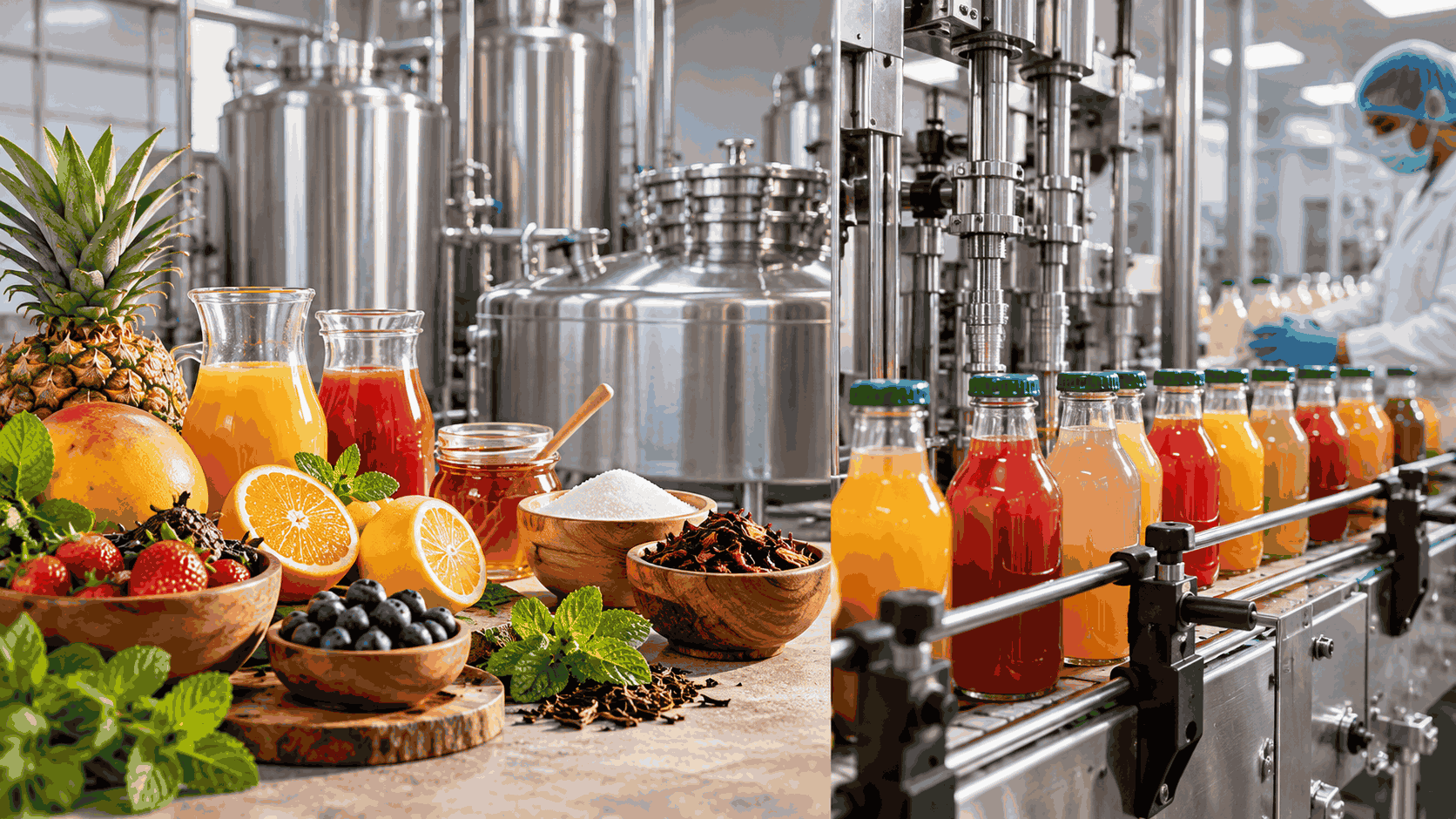
Choosing appropriate Raw Materials for Beverages is one of the most important steps in manufacturing. Ingredients may include water, fruit pulp, juice concentrates, tea extracts, coffee, sugar, sweeteners, flavours, colours, and permitted stabilisers, depending on the product formulation.
Manufacturers should evaluate ingredient quality, specifications, supplier documentation, and compatibility before using materials in production. Water quality is particularly important because water forms a major part of many beverage formulations and can influence taste and product consistency.
Incoming ingredients should be checked against defined quality parameters before production begins. Proper sourcing and material inspection help reduce variations and support reliable manufacturing.
Beverage Formulation and Product Development
Beverage Formulation involves combining ingredients in carefully evaluated proportions to achieve the intended taste, colour, aroma, texture, and overall product characteristics.
During development, manufacturers may conduct multiple trials to adjust sweetness, acidity, flavour intensity, and ingredient balance. They also evaluate how the formulation performs during processing and storage.
Sampling and sensory evaluation help determine whether the beverage meets the desired product profile. Process trials can further establish suitable manufacturing conditions before scaling up.
EXIITO supports product development through its R&D and Quality Control services, which include recipe development, sampling, sensory checks, process trials, and formulation adjustments.
Beverage Processing and Manufacturing
Once the formulation is approved, the beverage moves into the processing stage. Beverage Processing varies according to the ingredients, product category, and required shelf-life conditions.
Depending on the formulation, manufacturing may involve filtration, blending, mixing, homogenisation, heating, cooling, or other suitable processing methods. For certain beverages, thermal processing may be used to control microorganisms and support product stability. The selected treatment must be validated for the specific product and packaging system.
Beverage Manufacturing Equipment plays an important role in maintaining process consistency. Mixing tanks, filtration systems, processing units, transfer pumps, and temperature-monitoring instruments may be used depending on production requirements.
Equipment selection should consider product characteristics, batch size, hygiene requirements, and compatibility with the manufacturing process.
Beverage Quality Control and Safety Standards
Beverage Quality Control is essential throughout manufacturing, not just at the final inspection stage. Quality checks should cover incoming ingredients, processing conditions, and finished products.
Depending on the beverage, manufacturers may monitor parameters such as pH, acidity, sweetness, appearance, flavour, temperature, and filling volume. Packaging integrity and batch documentation are also important for product verification and traceability.
Following applicable Beverage Safety Standards requires suitable hygiene practices, documented procedures, trained personnel, and appropriate quality checks. Manufacturers should also ensure that processing conditions and product labelling comply with relevant food safety and regulatory requirements.
EXIITO outlines its approach to incoming checks, in-process monitoring, finished-goods inspection, and traceability through its Quality Assurance system.
Beverage Filling and Packaging
After processing and the required quality checks, the beverage moves to filling and packaging. Beverage Filling and Packaging involves transferring the finished product into suitable containers while maintaining hygienic handling and accurate filling quantities.
Common packaging options include glass bottles, PET bottles, cans, and cartons. The right choice depends on the beverage formulation, processing method, storage conditions, transportation requirements, and brand positioning.
Bottles or other containers are prepared according to the filling system. After filling, containers are sealed, labelled, coded, and inspected as required. Packaging compatibility is particularly important because the container and closure must suit the product and its processing conditions.
This stage transforms processed beverages into finished retail products ready for storage and distribution.
Challenges and Future Trends in Beverage Manufacturing
Beverage manufacturers face challenges such as changing ingredient costs, maintaining consistent taste, managing shelf-life requirements, reducing production losses, and selecting appropriate packaging. Scaling a formulation from laboratory samples to larger production batches can also require careful adjustments.
The industry is increasingly exploring improved processing equipment, automation, resource-efficient operations, and packaging innovations. These developments may help manufacturers improve production planning, monitor quality, and respond to changing consumer preferences.
However, technology must be selected according to actual product requirements, production capacity, and food safety considerations.
Conclusion
The Beverage Manufacturing Process involves several connected stages, from selecting quality ingredients and developing formulations to processing, quality control, filling, and packaging. Each step contributes to the taste, consistency, safety, and presentation of the finished beverage.
For businesses planning to launch or expand a beverage brand, choosing an experienced manufacturing partner can help organise product development and production requirements.
Planning to develop your own beverage brand? Explore EXIITO’s beverage manufacturing services to learn about product development, OEM, ODM, and other manufacturing solutions. You can also contact the EXIITO team to discuss your beverage concept, formulation, packaging preferences, and production requirements.