
Introduction
The food manufacturing industry is evolving as businesses adopt modern technologies to improve production efficiency, maintain product quality, and manage operational costs. Traditional manufacturing methods often depend on manual monitoring, repetitive tasks, and delayed reporting, which can limit productivity and increase the risk of errors. Smart manufacturing in food industry operations offers a more efficient approach by combining automation, connected equipment, digital monitoring, and data analysis.
With the growing demand for consistent quality, faster production, and reliable supply, manufacturers are increasingly exploring advanced production systems. These technologies help businesses monitor manufacturing activities, identify operational problems, and make informed decisions. Smart manufacturing is becoming an important part of modern food production, supporting better resource utilisation, improved traceability, and more consistent manufacturing processes.
Understanding Smart Manufacturing in Food Production
Smart manufacturing in food production involves integrating digital technologies, automated equipment, sensors, and data management systems into manufacturing operations. These systems collect and analyse production information, helping manufacturers understand how their processes perform and where improvements are required.
Unlike conventional manufacturing, where employees may need to inspect equipment and record production data manually, connected systems can provide continuous information about machine performance, production speed, temperature, and other relevant operating conditions. This enables production teams to identify deviations earlier and respond more effectively.
Industry 4.0 in food processing brings together technologies such as the Internet of Things, artificial intelligence, robotics, and industrial automation. When implemented appropriately, these technologies can help manufacturers improve productivity while maintaining established quality and food safety requirements.
How Food Production Line Automation Improves Efficiency
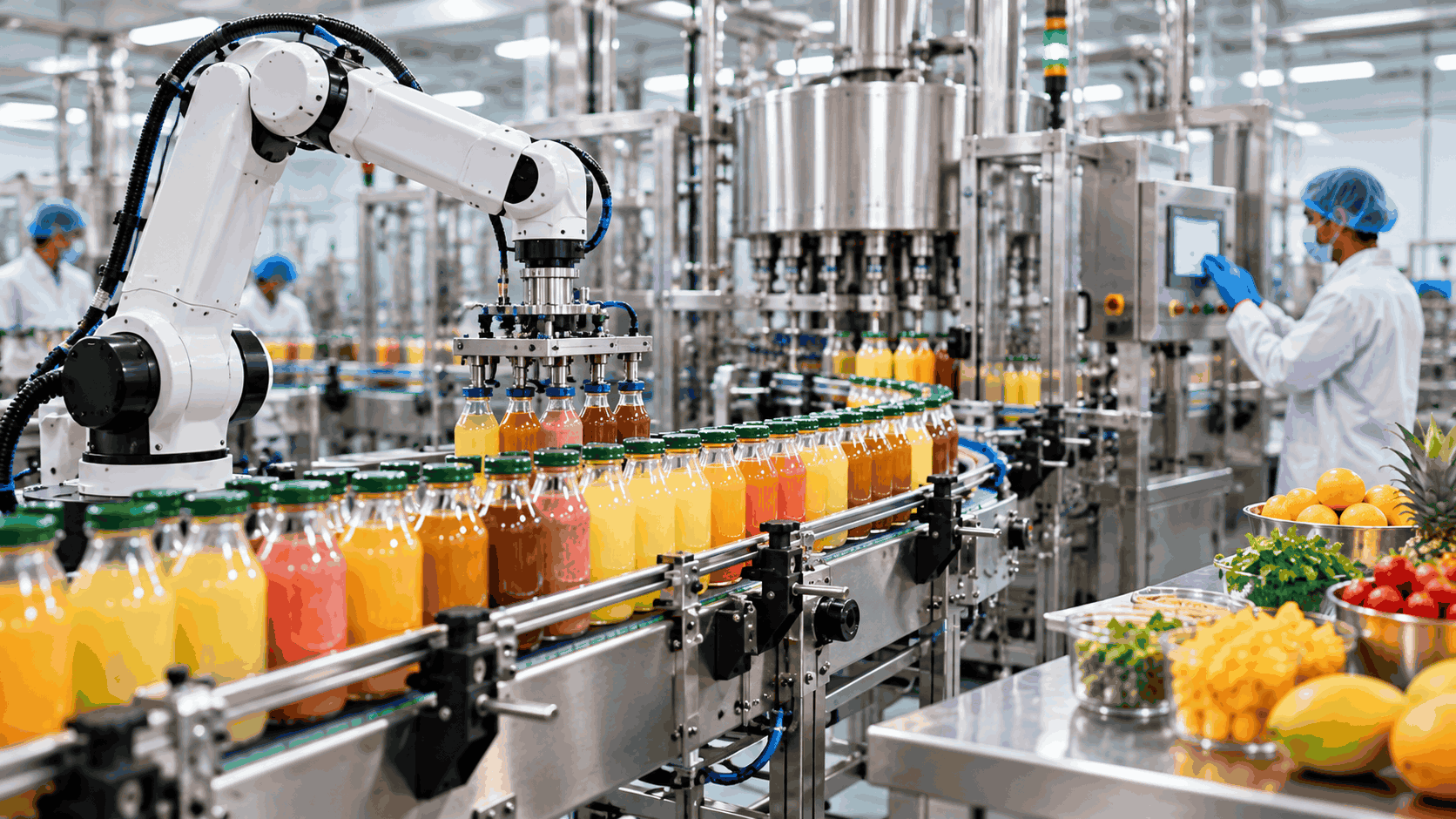
Food production line automation reduces dependence on repetitive manual operations by using machines and control systems to perform specific manufacturing tasks. Depending on the product and facility, automation may support ingredient handling, mixing, processing, filling, sealing, labelling, and packaging.
Automated food manufacturing systems can help maintain consistent operating conditions and reduce variations between production batches. For example, automated filling equipment can dispense predetermined quantities, while conveyor systems can move products between processing stages with fewer manual handling requirements.
Automation also allows employees to focus on activities that require supervision, technical knowledge, problem-solving, and quality assessment. However, automation should be selected according to production volume, product characteristics, available infrastructure, and business requirements rather than implemented without a clear operational objective.
Digital Transformation in Food Manufacturing
Digital transformation in food manufacturing involves replacing disconnected manual records and isolated systems with integrated digital tools. Production management software, electronic batch records, inventory systems, and manufacturing execution systems can help businesses maintain more organised production information.
These systems allow authorised employees to review manufacturing data, monitor production progress, and identify recurring operational issues. Digital records can also improve communication between production, quality assurance, maintenance, procurement, and warehouse teams.
For manufacturers handling several products or packaging formats, digital systems can support better production scheduling and documentation. They can also help businesses identify delays, track material usage, and review performance across different production batches.
The success of digital transformation depends on reliable data, suitable infrastructure, employee training, and clear procedures for maintaining accurate records.
The Role of IoT in Food Manufacturing
The Internet of Things, commonly known as IoT, connects sensors, machines, and monitoring devices so that relevant operational information can be collected and shared. IoT in food manufacturing can help production teams monitor equipment performance and environmental conditions throughout the manufacturing process.
Depending on the application, connected sensors may measure temperature, humidity, pressure, flow rates, or machine vibration. In temperature-sensitive food production, continuous monitoring can help operators identify conditions that move outside established operating limits.
For example, a temperature sensor connected to a monitoring system can alert employees when a processing or storage condition requires attention. This allows corrective action to be taken sooner than it might be with occasional manual checks.
IoT systems can improve visibility across production operations, but sensors must be properly installed, calibrated, maintained, and reviewed to ensure that the information they provide remains reliable.
Artificial Intelligence in Food Processing
Artificial intelligence in food processing helps manufacturers analyse production data, recognise patterns, and support operational decisions. AI applications can be used for visual inspection, demand forecasting, production planning, equipment monitoring, and identifying unusual process behaviour.
For instance, computer vision systems may inspect product appearance, packaging alignment, label placement, or visible defects. These systems can help identify inconsistencies at production speed, although their performance depends on suitable equipment, training data, and validation.
AI can also support the analysis of historical production records to identify factors associated with downtime, material waste, or quality variations. Manufacturers can use these insights to investigate recurring problems and improve production procedures.
Artificial intelligence should complement established quality assurance practices rather than replace necessary human supervision, laboratory testing, or food safety controls.
Real-Time Monitoring in Food Production
Real-time monitoring in food production gives manufacturers timely access to information about production conditions, machine status, and operational performance. Instead of relying entirely on reports prepared after a shift has ended, supervisors can review relevant information while manufacturing activities are taking place.
Monitoring dashboards can display production quantities, equipment availability, process temperatures, line stoppages, and other selected indicators. When a parameter moves outside its approved range, the system may notify the responsible employee so that the issue can be investigated.
This approach can help reduce response times and improve coordination between departments. It also supports more informed decisions about production scheduling, resource allocation, and corrective actions.
For monitoring systems to be effective, manufacturers need clearly defined operating limits, reliable sensors, appropriate alert procedures, and employees who understand how to respond to deviations.
Predictive Maintenance in Food Manufacturing
Unexpected equipment failures can interrupt production, delay orders, increase repair expenses, and affect delivery schedules. Predictive maintenance in food manufacturing uses equipment condition data and historical performance information to help identify possible failures before they cause significant disruption.
Sensors may track vibration, temperature, operating hours, or other indicators of machine condition. Maintenance teams can review these patterns to identify unusual behaviour and schedule inspections or repairs when needed.
Compared with purely reactive maintenance, predictive approaches can help manufacturers plan maintenance activities more effectively and reduce avoidable downtime. However, predictive maintenance does not eliminate the need for routine servicing, equipment inspections, or manufacturer-recommended maintenance schedules.
A practical maintenance strategy combines preventive servicing, condition monitoring, maintenance records, and prompt investigation of equipment abnormalities.
Quality Control in Food Processing
Quality control in food processing remains essential even when production lines become highly automated. Smart manufacturing technologies can strengthen quality management by improving process monitoring, documenting production parameters, and identifying deviations that require investigation.
Digital quality systems can record inspection results, batch information, ingredient details, and relevant processing conditions. When integrated with suitable production systems, these records can help manufacturers investigate complaints, identify affected batches, and support traceability procedures.
Automated inspection equipment may also identify certain packaging defects, incorrect labels, or visible product inconsistencies. However, manufacturers must select inspection methods appropriate to their products and validate their effectiveness.
Technology cannot replace a comprehensive food safety management system. Sanitation, employee hygiene, allergen management, appropriate testing, equipment calibration, and compliance with applicable regulations remain essential components of responsible manufacturing.
Food Manufacturing Process Optimization Through Data
Food manufacturing process optimization involves analysing production activities to identify opportunities for improving output, reducing losses, and maintaining consistent standards. Data-driven food manufacturing makes this process more systematic by using recorded information rather than relying only on assumptions or individual experience.
Manufacturers can review indicators such as production output, downtime, material consumption, rejected products, changeover duration, and energy usage. These measurements help teams understand where resources are being used inefficiently and which improvements may provide the greatest benefit.
For example, production data may reveal that frequent changeovers are reducing available operating time or that certain process conditions are associated with higher rejection rates. Corrective actions can then be tested and evaluated against measurable results.
A structured improvement process should establish baseline performance, identify the underlying cause of a problem, implement a suitable change, and review the outcome. This ensures that improvements are supported by evidence and do not compromise product quality or safety.
Advanced Food Production Technologies and Resource Management
Advanced food production technologies can help manufacturers manage ingredients, packaging materials, utilities, and finished goods more effectively. Automated weighing systems, digital inventory records, connected production equipment, and energy monitoring tools can improve visibility into resource consumption.
Accurate ingredient measurement can reduce avoidable formulation variations and material losses. Effective inventory monitoring enables production teams to align raw material availability with manufacturing schedules, minimize delays, and maintain a smooth and consistent production workflow. Energy monitoring can also reveal opportunities to reduce unnecessary electricity, water, or compressed air consumption.
Manufacturers should evaluate these improvements in relation to their products, facility design, and operating requirements. Equipment investment, maintenance costs, employee training, and expected production benefits should all be considered before adopting new technologies.
For businesses exploring external production capacity, EXIITO's contract manufacturing services provide information about manufacturing arrangements, production planning, quality checks, and dispatch for supported food categories.
Challenges in Implementing Smart Manufacturing
Although smart manufacturing offers significant opportunities, implementation can present practical challenges. High initial investment, integration with existing equipment, cybersecurity concerns, employee training, and data quality can influence the success of a project.
Smaller manufacturers may find it difficult to replace entire production lines at once. A step-by-step implementation strategy can help manufacturers address key operational challenges, starting with issues such as frequent machine breakdowns, manual recordkeeping, or variations in product filling volumes.
Manufacturers should assess their current processes, identify measurable improvement targets, and select technologies that address those priorities. Employee training is equally important because operators and supervisors must understand how to use the systems and respond to alerts.
Businesses should also establish access controls, backup procedures, equipment maintenance schedules, and clear responsibilities for managing digital information. These measures can help ensure that technology investments provide lasting operational value.
The Future of Smart Manufacturing in the Food Industry
The future of smart manufacturing in food industry operations will likely involve greater integration between automation, connected equipment, artificial intelligence, and digital production management. With the growing availability of advanced manufacturing technologies, food producers can enhance production planning, improve product traceability, minimize material wastage, and track equipment performance more effectively.
Future systems may also enable closer coordination between suppliers, production facilities, warehouses, and distribution partners. Better information sharing can help businesses plan production according to demand and respond more effectively to supply chain changes.
However, successful transformation will depend on more than technology alone. Manufacturers will need reliable operating procedures, trained employees, appropriate investment decisions, and a continued focus on food safety and product quality.
Businesses seeking manufacturing partners can also review EXIITO's manufacturing capabilities to understand its supported product categories and manufacturing service models.
Conclusion
Smart manufacturing is transforming food production lines by combining automation, connected sensors, artificial intelligence, predictive maintenance, and data-driven decision-making. These technologies can help manufacturers improve operational efficiency, monitor production conditions, strengthen quality control, and manage resources more effectively.
The most successful approach is to adopt technology according to specific production requirements, measure its results, and maintain food safety and quality standards throughout the process. By combining modern systems with trained employees and disciplined operating procedures, food manufacturers can build more reliable and adaptable production operations.
If your business is exploring food manufacturing opportunities, visit EXIITO to learn more about its food manufacturing operations and partnership options. You can also contact the EXIITO team to discuss your product requirements and manufacturing enquiries.