
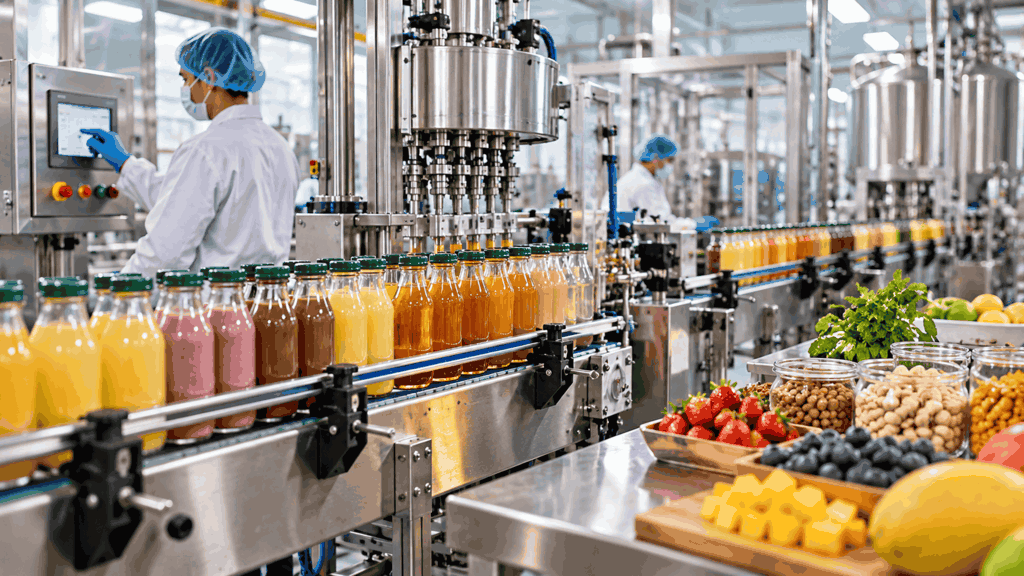
Introduction
Modern food processing technologies are transforming the way food manufacturers produce, package, and distribute products. As consumer demand grows and competition increases, manufacturers must improve productivity, maintain consistent quality, reduce operational costs, and meet food safety requirements. Traditional manufacturing methods are increasingly being supported by advanced machinery, automated production lines, digital monitoring systems, and energy-efficient processing solutions.
Modern Food Processing Technologies help businesses streamline daily operations, improve production accuracy, reduce material waste, and maintain consistent product standards. From ingredient preparation and processing to filling, packaging, and quality inspection, technological advancements are creating new opportunities for food manufacturers to improve efficiency and scale their operations.
For companies exploring professional manufacturing partnerships, EXIITO’s food manufacturing capabilities provide an overview of its production and partner manufacturing services across beverages, namkeen, makhana, flour, and pickles.
Understanding Modern Food Processing Technologies
Modern Food Processing Technologies include advanced equipment, automated machinery, digital systems, and improved processing methods used to manufacture food products efficiently and consistently. These technologies help manufacturers manage production activities with greater precision while supporting hygiene, product quality, and operational control.
Food processing technology can be applied throughout the manufacturing process, including raw material handling, mixing, cooking, pasteurisation, cooling, filling, sealing, labelling, and packaging. The specific technologies required depend on the product category, ingredients, processing conditions, packaging format, and applicable food safety standards.
Modern food manufacturing technology also supports better coordination between production teams, quality control personnel, maintenance departments, and supply chain operations. When these functions work together effectively, manufacturers can reduce unnecessary delays, identify production problems earlier, and improve overall manufacturing performance.
How Automation Improves Food Production Efficiency
Food processing automation plays an important role in improving manufacturing productivity. Automated machines can perform repetitive operations with consistent speed and accuracy, reducing dependence on manual handling and helping manufacturers maintain standardised production procedures.
Automated food production systems can support activities such as ingredient dosing, blending, filling, capping, sealing, labelling, and packaging. Depending on the system design, these technologies can reduce manual errors, improve throughput, and create more consistent output across production batches.
For example, an automated beverage filling line can control filling volumes more consistently than an unstandardised manual process. Automated capping and packaging equipment can also help manufacturers maintain uniform packaging quality and reduce avoidable product losses.
Automation does not eliminate the need for skilled workers. Instead, it allows employees to focus on equipment supervision, quality checks, maintenance, and process improvement. The result can be a more organised production environment with better use of labour and manufacturing resources.
Advanced Food Processing Equipment and Manufacturing Performance
Modern food processing machinery enables manufacturers to handle raw ingredients and finished products efficiently while maintaining consistent operating conditions and supporting product quality and safety. Modern mixers, industrial cooking systems, pasteurisation units, homogenisers, cooling systems, filling machines, and packaging equipment can improve consistency and reduce unnecessary processing delays.
Selecting the right industrial food processing equipment is essential because every product has different processing requirements. Beverages may require controlled mixing, thermal processing, cooling, and hygienic filling, while snack products may require frying, roasting, seasoning, or moisture control.
Well-designed equipment can improve processing speed, support accurate temperature and time control, and reduce product variation. Equipment capacity should also match the requirements of the production line. A high-capacity processing machine may not improve overall efficiency if packaging equipment or another production stage cannot handle the same output.
Manufacturers should therefore evaluate the complete production process before investing in new machinery. Coordinating equipment capacity, maintenance requirements, hygiene procedures, and operator training helps ensure that technological improvements deliver practical results.
Smart Food Processing Systems and Digital Transformation
Smart food processing systems combine sensors, connected equipment, digital monitoring, and data analysis to improve manufacturing visibility. These systems help production teams understand what is happening on the factory floor and identify issues that may affect output, quality, or equipment performance.
The digital transformation in food processing can include real-time monitoring of production parameters, automated recording of batch information, equipment performance tracking, and digital quality documentation. Depending on the system, manufacturers may also receive alerts when temperatures, processing times, or other monitored parameters move outside approved limits.
The Internet of Things can connect suitable production equipment to monitoring platforms, allowing authorised personnel to review operational data more efficiently. Artificial intelligence can also support selected applications, such as identifying visual packaging defects, detecting unusual machine behaviour, and analysing production trends.
These tools are most effective when manufacturers use accurate data and clearly defined procedures. Digital systems should support established food safety and quality management practices rather than replace essential inspections, validation, or trained human oversight.
Food Production Line Optimization for Better Output
Food production line optimization focuses on improving the performance of the entire manufacturing process rather than increasing the speed of one machine. A production line may include several interconnected stages, and a delay at any stage can affect the output of the complete operation.
Manufacturers can improve production flow by analysing machine utilisation, changeover time, waiting periods, material movement, and packaging capacity. Identifying bottlenecks helps businesses determine where adjustments or equipment upgrades are most likely to improve performance.
For example, if a packaging machine operates more slowly than the processing equipment supplying it, finished products may accumulate between the two stages. Improving packaging capacity, coordinating machine speeds, or adjusting production schedules can help reduce this imbalance.
Implementing standard operating procedures, scheduling regular equipment maintenance, streamlining material handling, and providing employee training can significantly enhance manufacturing efficiency and ensure consistent production quality. Regularly reviewing production data allows manufacturers to identify recurring problems and make informed decisions about process adjustments.
Energy-Efficient Food Processing and Waste Reduction
Energy-efficient food processing is becoming increasingly important as manufacturers look for ways to control operating costs and use resources responsibly. Processing equipment, refrigeration, heating, compressed air, ventilation, and packaging operations can all contribute to a facility’s energy consumption.
Manufacturers can improve energy performance by maintaining equipment, reducing unnecessary idle time, insulating suitable heating and cooling systems, and monitoring energy consumption across production stages. Energy-efficient motors and appropriately sized equipment can also help reduce electricity usage when selected for the actual operating requirements.
Water management and waste reduction are equally important. Better process control can help minimise rejected products, ingredient losses, excessive cleaning water, and packaging waste. Preventive maintenance can reduce leaks, unexpected breakdowns, and inefficient equipment operation.
Energy and resource improvements should be measured against actual production output. Tracking energy consumption per unit of product, water use, material waste, and rejected batches provides a clearer picture of whether a process improvement is delivering measurable benefits.
Food Quality Control Technology and Product Consistency
Food quality control technology supports consistent product standards throughout manufacturing. Modern monitoring instruments, calibrated measuring equipment, automated inspection systems, and digital records can help manufacturers identify deviations before they affect large quantities of finished products.
Depending on the product, quality checks may include temperature, pH, moisture, weight, filling volume, packaging integrity, appearance, and other relevant specifications. Automated inspection systems can assist with identifying certain defects, while laboratory testing and trained quality personnel remain important for verifying product safety and compliance.
For beverage manufacturers, consistent formulation, appropriate processing conditions, hygienic filling, and secure packaging are important considerations. For snack and pickle production, moisture levels, texture, ingredient distribution, packaging integrity, and other product-specific parameters may require attention.
A reliable quality management approach combines suitable technology with documented procedures, staff training, traceability, and corrective action. These measures help manufacturers maintain consistency while supporting customer confidence and compliance with applicable requirements.
The Role of Modern Technology in Scaling Food Manufacturing
Growing food businesses often need to increase production without losing control over product quality, costs, or delivery schedules. Modern Food Processing Technologies can support this growth by improving production planning, reducing repetitive manual work, and helping manufacturers manage larger volumes more systematically.
Scalable equipment, standardised recipes, documented process parameters, and reliable packaging systems make it easier to repeat approved production processes. Digital production records can also help teams compare batches, investigate variations, and plan future manufacturing requirements.
However, scaling successfully requires more than installing advanced machinery. Manufacturers must assess demand, production capacity, ingredient availability, packaging supply, staffing, maintenance support, and quality assurance requirements. New equipment should be integrated carefully, with appropriate testing and operator training before full-scale operation.
Businesses that do not wish to establish their own manufacturing facilities may also consider an external manufacturing partner. EXIITO offers contract manufacturing services for businesses seeking production support across beverages and selected food categories. The suitability of any manufacturing arrangement depends on the product requirements, agreed specifications, production capacity, and commercial terms.
Choosing the Right Food Processing Technology
Selecting the right technology begins with understanding the product and the manufacturing objective. Businesses should assess current production volumes, expected growth, quality requirements, processing conditions, packaging needs, and available investment before deciding which technologies to adopt.
The total cost of ownership should include equipment purchase, installation, energy consumption, maintenance, spare parts, operator training, and potential production downtime. Manufacturers should also consider whether the equipment can accommodate future product variations and changing demand.
Food safety and hygiene must remain central to every technology decision. Equipment should be suitable for the intended application, compatible with the required cleaning procedures, and capable of supporting relevant regulatory and quality requirements.
A phased implementation strategy can help businesses manage investment risk. Starting with a clearly identified production bottleneck, measuring the results, and expanding successful improvements can be more practical than upgrading an entire facility at once.
For businesses looking for manufacturing support, EXIITO’s manufacturing services explain available partner models, including private label, white label, contract, third-party, OEM, and ODM manufacturing. Businesses can review these options to understand which arrangement may align with their product development and production goals.
Conclusion
Modern Food Processing Technologies are helping manufacturers improve production efficiency, strengthen quality control, reduce waste, and respond to changing market demands. Automation, advanced equipment, smart monitoring systems, energy-efficient processes, and digital production records can all contribute to better manufacturing performance when implemented according to specific operational requirements.
Long-term improvement depends on combining the right technology with skilled employees, effective maintenance, reliable quality systems, and continuous performance monitoring. By identifying bottlenecks, standardising processes, and investing in suitable solutions, food manufacturers can build more efficient and scalable production operations.
If your business is planning to launch a food product, expand production, or explore an external manufacturing partnership, visit EXIITO Beverages to learn more about its manufacturing capabilities and product categories. You can also contact EXIITO to discuss your product requirements, packaging preferences, and potential manufacturing needs.