
Introduction
Food manufacturing companies face increasing pressure to manage production expenses while maintaining consistent product quality, food safety, and customer satisfaction. Rising raw material prices, energy consumption, labour expenses, packaging costs, and operational inefficiencies can affect profitability. Therefore, Food Manufacturing Cost Reduction has become an important priority for manufacturers seeking sustainable growth and long-term competitiveness.
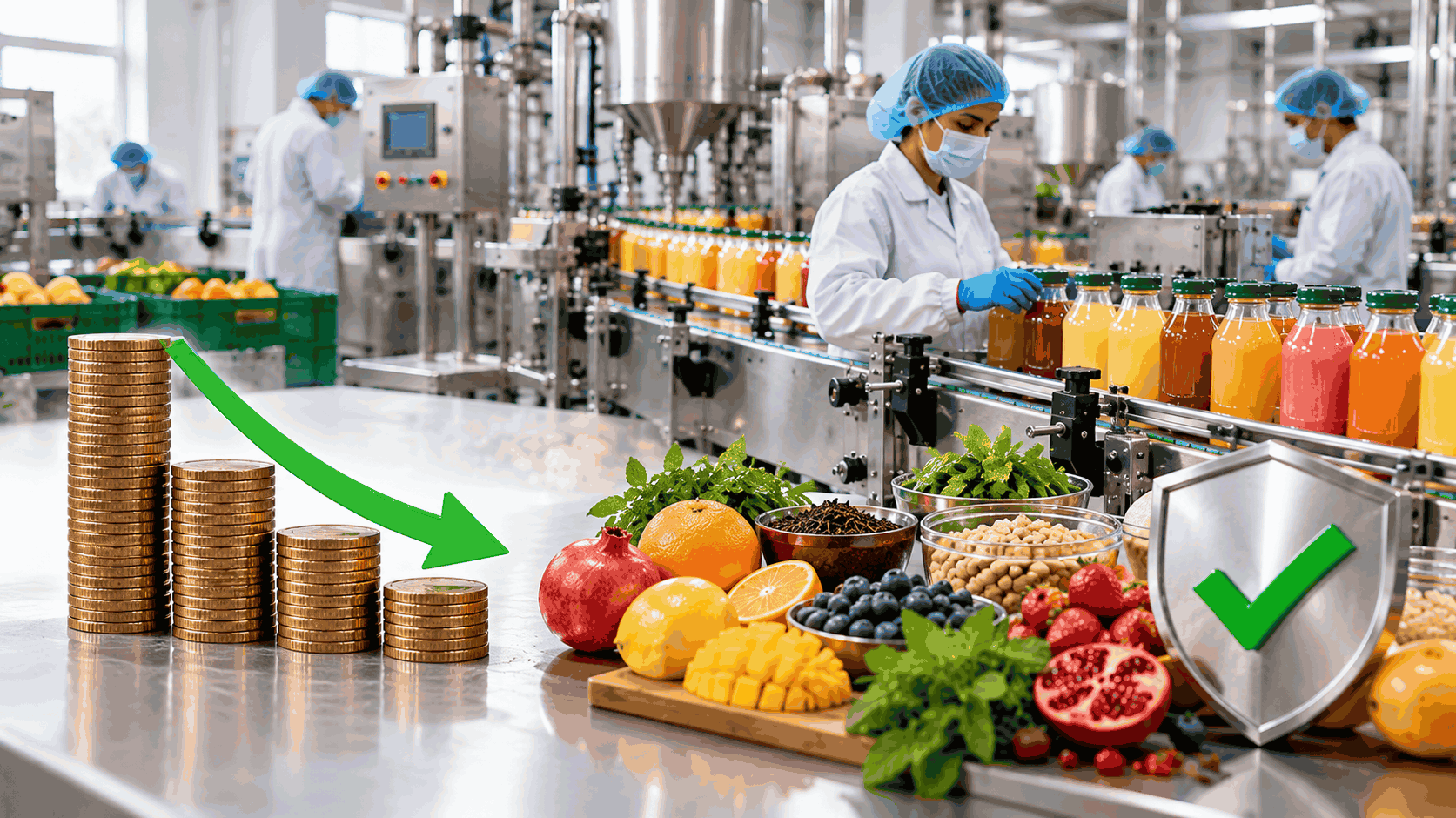
However, reducing costs should never mean lowering ingredient quality, neglecting hygiene, or compromising established food safety standards. Instead, businesses should focus on improving production planning, reducing waste, optimising resource utilisation, and implementing effective quality management practices. By adopting practical cost-control strategies, manufacturers can improve operational performance while delivering safe, reliable, and high-quality food products.
Understanding Food Manufacturing Costs
The first step towards reducing manufacturing expenses is understanding where the money is being spent. Food processing operations typically involve raw materials, packaging, labour, utilities, equipment maintenance, storage, transportation, and quality control. Even small inefficiencies in these areas can increase overall production costs when repeated across multiple batches.
Manufacturers should regularly review their operating expenses and calculate the cost per unit or production batch. Comparing actual costs with planned budgets helps identify unexpected spending, excessive material consumption, and inefficient processes. Accurate cost tracking also supports better purchasing decisions and production planning.
A structured approach to cost optimization in food manufacturing allows businesses to prioritise improvements according to their financial impact without weakening product specifications or safety requirements.
Optimising Raw Material Procurement
Raw materials often represent a significant portion of total food production expenses. Effective raw material cost optimization begins with selecting reliable suppliers, negotiating suitable purchasing terms, and forecasting ingredient requirements accurately.
Manufacturers should evaluate suppliers based on price, consistency, quality, delivery reliability, and compliance with applicable food safety requirements. Purchasing the cheapest available ingredients may create additional expenses if they result in inconsistent products, production delays, or higher rejection rates.
Demand forecasting can also help businesses determine appropriate purchasing quantities. Buying according to realistic production requirements reduces unnecessary inventory accumulation and limits the risk of expiry or deterioration. Where suitable, manufacturers can negotiate volume-based pricing or establish longer-term supplier agreements to improve purchasing stability.
These practices support food production cost reduction while helping businesses maintain consistent ingredient quality and reliable product performance.
Reducing Waste in Food Manufacturing
Material waste is one of the most common sources of avoidable manufacturing expenses. Ingredient spillage, inaccurate weighing, damaged packaging, overproduction, product rejection, and improper storage can increase costs without creating additional value.
Manufacturers should identify the stages where waste occurs and establish measurable targets for improvement. Monitoring material usage, recording production losses, and analysing rejected batches can reveal recurring operational problems. Employees should also receive appropriate training in material handling, equipment operation, cleaning procedures, and inventory management.
The first-in, first-out method and expiry-date-based inventory controls can help ensure that materials are used within their appropriate storage periods. Temperature, humidity, and storage conditions should be monitored according to the requirements of individual ingredients and finished products.
Reducing waste in food manufacturing improves resource utilisation and profitability while supporting responsible production practices. Waste management strategies should prioritize minimizing preventable losses while ensuring that any material reuse practices comply with food safety standards and do not compromise product quality.
Improving Production Planning and Operational Efficiency
Efficient production planning helps manufacturers use equipment, labour, and materials more effectively. Poor scheduling can result in frequent changeovers, unnecessary downtime, overtime expenses, and underutilised production capacity.
Businesses should align production schedules with customer demand, inventory availability, equipment capacity, and delivery commitments. Grouping compatible products into suitable production runs can reduce changeover time, cleaning-related downtime, and material losses, provided that required hygiene and allergen-control procedures are maintained.
Standard operating procedures can further improve consistency by defining how each production activity should be performed. Regular performance reviews help identify bottlenecks, unnecessary movements, and repeated manual tasks that slow down operations.
Improving food manufacturing efficiency also requires clear communication between purchasing, production, quality assurance, warehousing, and dispatch teams. Coordinated planning reduces delays and supports more predictable manufacturing costs.
Using Automation to Reduce Production Costs
Food processing automation can improve accuracy, consistency, and production speed when implemented according to operational requirements. Automated weighing systems, filling equipment, temperature monitoring devices, mixing controls, and inspection technologies can help reduce manual errors and material losses.
For example, accurate filling equipment can reduce product giveaway caused by excessive filling. Automated monitoring can help operators identify process deviations earlier, while suitable inspection systems can improve defect detection and reduce unnecessary product rejection.
However, automation requires careful financial evaluation. Manufacturers should consider installation costs, maintenance requirements, employee training, equipment compatibility, expected production volumes, and potential savings before investing in new systems.
A gradual implementation strategy may be more practical than replacing an entire production line immediately. Businesses can begin with processes that experience frequent errors, high labour requirements, or significant material losses and measure the results before expanding automation.
Improving Energy Efficiency in Food Processing
Electricity, fuel, refrigeration, heating, and compressed air can contribute substantially to operating expenses. Energy efficiency in food processing therefore offers opportunities to reduce costs without changing product formulations or lowering quality standards.
Manufacturers should monitor energy consumption across major equipment and production activities to identify areas of excessive usage. Regular maintenance of motors, refrigeration systems, pumps, compressors, and heating equipment can improve performance and prevent avoidable energy losses.
Production schedules can also be reviewed to reduce unnecessary equipment operation during idle periods. Appropriate insulation, efficient lighting, preventive maintenance, and energy-efficient equipment may provide additional savings over time.
Any adjustments to heating, cooling, pasteurisation, refrigeration, or other critical processing conditions must be validated to ensure that food safety and product specifications remain protected. Energy savings should never come at the expense of safe processing conditions.
Strengthening Quality Control in Food Manufacturing
Quality control in food manufacturing is essential to maintaining consumer trust, meeting regulatory requirements, and avoiding costly product failures. Poor quality can lead to rejected batches, customer complaints, product recalls, and damage to brand reputation.
Manufacturers should establish documented quality procedures covering incoming raw materials, processing conditions, packaging integrity, finished-product inspection, and batch traceability. Routine testing and process monitoring can help identify deviations before they affect larger quantities of products.
Preventive quality measures are often more economical than correcting problems after production. For example, calibrating weighing equipment, verifying temperature controls, and checking packaging seals can reduce defects and prevent avoidable rework.
Employees should understand their responsibilities for hygiene, accurate documentation, and reporting deviations. A strong quality culture encourages early problem identification and supports continuous improvement.
Maintaining food quality while reducing costs requires businesses to eliminate inefficiencies rather than remove essential quality checks, approved ingredients, or food safety controls.
Managing Inventory and Storage Costs
Effective inventory management helps prevent both material shortages and excess stock. Overstocking increases storage expenses and exposes businesses to deterioration, expiry, and working capital pressure. Understocking can interrupt production, delay orders, and increase emergency purchasing costs.
Manufacturers should maintain accurate inventory records, establish appropriate stock levels, and regularly reconcile physical stock with recorded quantities. Forecasting tools and inventory management software can improve visibility into material availability and upcoming requirements.
Storage areas should be organised according to ingredient characteristics, shelf-life requirements, hygiene standards, and product compatibility. Clear identification and suitable stock rotation procedures help employees locate materials quickly and reduce avoidable losses.
Better inventory planning supports food processing cost management by balancing purchasing, storage, and production requirements.
Maintaining Cost-Effective Packaging
Packaging protects food products, supports shelf-life requirements, and communicates essential product information. Although packaging cost reduction can improve margins, changes must be assessed carefully to ensure that product protection and regulatory compliance remain intact.
Manufacturers can review packaging specifications, compare approved suppliers, reduce avoidable packaging waste, and optimise carton dimensions for storage and transportation. Standardising suitable packaging components across compatible products may also simplify purchasing and inventory management.
Before introducing alternative packaging materials or formats, businesses should evaluate product compatibility, sealing performance, durability, transport conditions, and applicable labelling requirements. Packaging trials and quality checks can help verify that the proposed changes meet the required standards.
The objective is to achieve cost-effective food production through better packaging utilisation and purchasing efficiency, not by reducing the protection necessary to deliver safe products to customers.
Monitoring Performance and Continuous Improvement
Sustainable cost reduction requires regular measurement rather than occasional expense-cutting exercises. Manufacturers should establish key performance indicators such as production cost per unit, material waste percentage, energy consumption per batch, equipment downtime, product rejection rates, and on-time delivery performance.
Reviewing these indicators over time helps management understand whether operational changes are producing meaningful improvements. Comparing results across production lines, shifts, or product categories can also reveal opportunities for further optimisation.
Employees should be encouraged to identify practical improvements and report recurring problems. Management can evaluate these suggestions based on feasibility, expected savings, quality implications, and implementation costs.
Manufacturers seeking additional production capacity may also evaluate external manufacturing partnerships. Depending on their requirements, working with an established partner can reduce the need for immediate investment in new facilities or equipment. Businesses can explore EXIITO's contract manufacturing solutions to understand how outsourced production may support their manufacturing plans.
Conclusion and CTA
Reducing food manufacturing costs without compromising quality requires a balanced approach that combines accurate cost tracking, efficient procurement, waste prevention, production planning, energy management, appropriate automation, and strong quality control. Rather than focusing only on immediate savings, manufacturers should improve the processes that influence long-term operational performance.
By implementing measurable improvements and reviewing results regularly, food businesses can control expenses, improve productivity, reduce avoidable losses, and maintain consistent product standards. Successful food manufacturing process optimization ultimately depends on making better use of resources while protecting food safety and customer satisfaction.
For businesses looking to develop or scale their food product range, EXIITO provides manufacturing support across beverages, namkeen, makhana, and pickles. Explore EXIITO's manufacturing capabilities or learn about its manufacturing services to discover suitable options for your business requirements.