Introduction
The food and beverage industry is experiencing a major shift towards responsible manufacturing and environmentally conscious consumption. As consumers become more aware of environmental issues, businesses are rethinking how their products are packaged, transported, stored, and presented. Packaging is no longer just a way to protect products; it has become an important part of brand identity and environmental responsibility.
Sustainable Food Packaging Solutions are gaining importance across the Fast-Moving Consumer Goods (FMCG) sector. Manufacturers are exploring materials and technologies that reduce packaging waste, improve recyclability, and maintain product safety. From recyclable containers to biodegradable materials, food packaging innovations are helping businesses balance product protection, customer expectations, and environmental considerations.
Why Sustainable Food Packaging Matters in the FMCG Industry
Traditional packaging materials, particularly single-use plastics, create challenges related to waste management and resource consumption. As FMCG products are manufactured and distributed in large volumes, packaging decisions can have a significant environmental impact.
Adopting sustainable food packaging can help businesses reduce unnecessary material usage, improve waste management, and strengthen their environmental commitments. It can also influence purchasing decisions, as environmentally conscious customers increasingly consider packaging when evaluating products and brands.
For manufacturers, sustainable packaging solutions for FMCG products offer an opportunity to improve operational practices while preparing for changing market expectations and packaging regulations.
Types of Sustainable Food Packaging Materials
1. Recyclable Food Packaging Materials
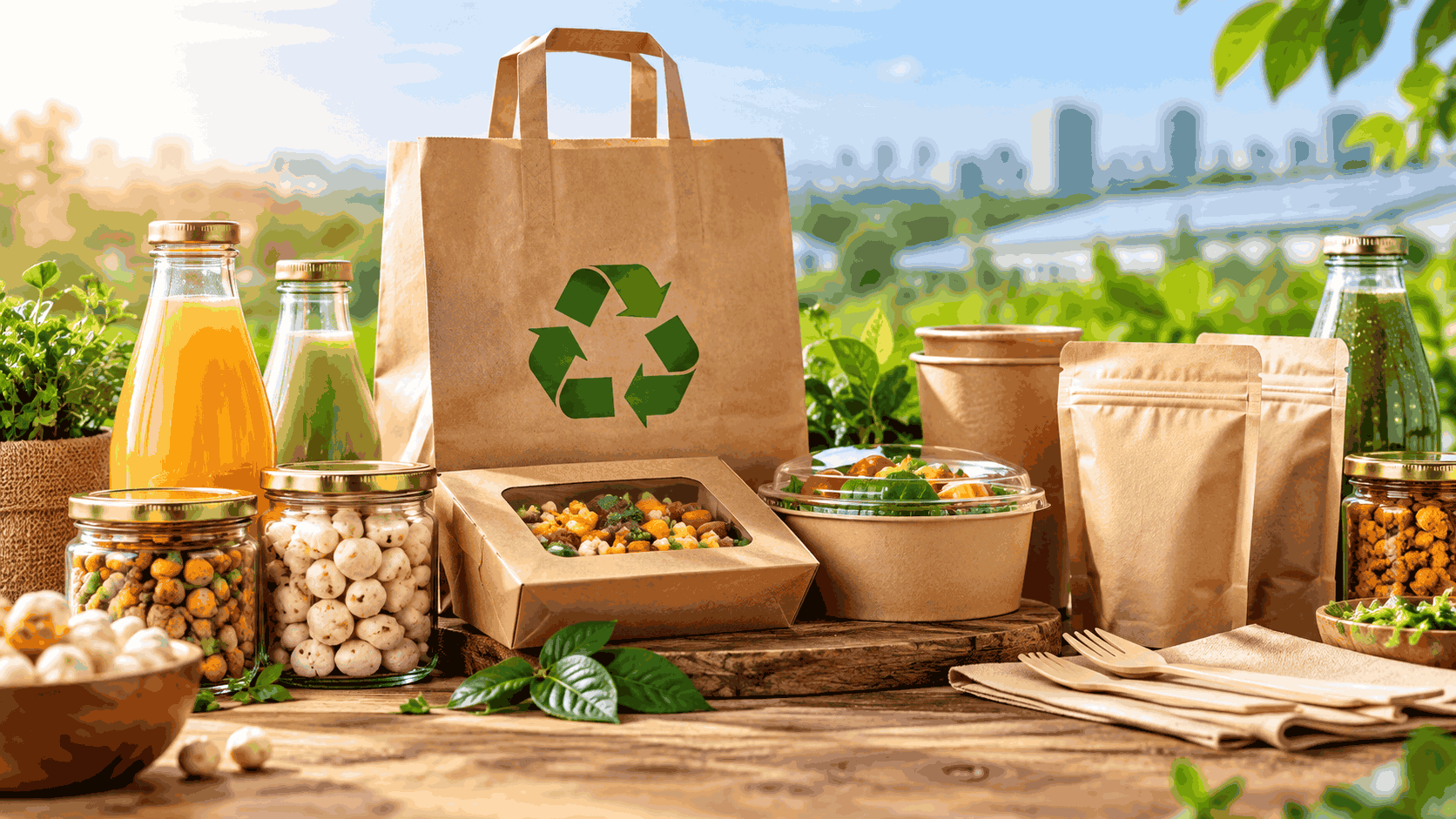
Recyclable materials are an important part of environmentally friendly packaging strategies. Glass, aluminium, paper, cardboard, and certain plastics can be recycled through appropriate collection and processing systems.
Glass containers are particularly useful for selected food and beverage applications because they can be reused and recycled. Paper-based cartons and cardboard are also widely considered for secondary packaging, product protection, and transportation.
However, recyclability depends on material composition, local recycling infrastructure, collection systems, and packaging design. Manufacturers should evaluate the complete packaging structure rather than focusing on individual materials.
2. Biodegradable and Compostable Food Packaging
Biodegradable food packaging is developed to break down through biological processes under suitable environmental conditions. Compostable packaging is a more specific category designed to decompose under defined composting conditions.
Materials such as selected plant-based fibres, bagasse, and other renewable resources are being explored for food packaging applications. These alternatives may help reduce dependence on conventional plastics in suitable situations.
However, businesses must understand the difference between biodegradable and compostable materials. Not every biodegradable package is suitable for home composting, and some compostable materials require industrial composting facilities.
3. Plastic-Free and Paper-Based Packaging
Plastic-free food packaging is receiving attention from manufacturers looking to reduce conventional plastic usage. Paper-based packaging, moulded fibre containers, and other renewable materials are being developed for different food applications.
These materials can be useful for dry foods, snacks, and secondary packaging. However, moisture resistance, grease protection, product freshness, and shelf-life requirements must be considered before selecting an alternative.
How Food Packaging Innovations Are Transforming FMCG
Modern food packaging innovations are moving beyond material replacement. Manufacturers are also exploring lightweight packaging, improved barrier properties, reusable formats, and smarter packaging designs.
Lightweight packaging can reduce material consumption and may lower transportation-related emissions when it does not compromise product protection. Better-designed packaging can also improve storage efficiency and reduce unnecessary space during distribution.
Green packaging technology is supporting the development of packaging structures that balance functionality with environmental considerations. Digital printing and improved packaging design processes can also help businesses manage product information, branding, and production requirements more efficiently.
For businesses exploring food product development and manufacturing, EXIITO's manufacturing capabilities provide an overview of its manufacturing services and product categories.
Benefits and Challenges of Sustainable Packaging Solutions
Environmentally friendly packaging offers several potential benefits for food manufacturers. It can support waste reduction, encourage responsible material sourcing, strengthen brand reputation, and help businesses respond to changing customer expectations.
Sustainable packaging can also encourage innovation across manufacturing, product development, and supply chain management. Companies that evaluate packaging early in the product development process may identify opportunities to improve material efficiency and reduce unnecessary packaging.
However, adopting sustainable packaging solutions is not without challenges. Alternative materials may involve higher initial costs, limited availability, specialised machinery requirements, or performance limitations. Some lightweight or compostable materials may also require additional testing to ensure they provide sufficient protection against moisture, oxygen, contamination, and physical damage.
Manufacturers must consider product safety, shelf life, packaging compatibility, transportation conditions, and end-of-life disposal options before making changes. A packaging solution should be considered sustainable only when its overall environmental performance and practical suitability have been properly evaluated.
Future of Food Packaging: Trends Shaping the FMCG Sector
The future of food packaging will be influenced by material science, consumer preferences, technological improvements, and environmental regulations. Recyclable mono-material structures, renewable fibre-based packaging, reusable containers, and improved barrier technologies are among the areas receiving industry attention.
Another important development is the growing focus on packaging lifecycle assessment. Instead of evaluating a package only by its material, businesses are increasingly considering resource extraction, manufacturing, transportation, usage, and disposal.
Sustainable packaging trends will also encourage stronger collaboration between food manufacturers, packaging suppliers, retailers, and recycling organisations. Such partnerships can help businesses identify practical solutions that work across the entire supply chain.
FMCG packaging innovations will continue to focus on balancing product protection, cost efficiency, customer convenience, and environmental responsibility. Businesses should select packaging based on their product requirements, available recycling systems, and applicable regulations.
Conclusion
Sustainable Food Packaging Solutions are becoming an important part of the future of the FMCG industry. Recyclable materials, biodegradable alternatives, compostable packaging, and improved packaging technologies offer opportunities to reduce waste and support more responsible manufacturing practices.
However, successful implementation requires careful evaluation of product safety, material performance, cost, recyclability, and environmental impact. Businesses that approach packaging innovation strategically can build stronger brands while responding to the evolving needs of consumers and the food industry.
At EXIITO Beverages, we believe that quality, innovation, and responsible manufacturing practices are essential for the future of the food and beverage industry. Explore our premium food and beverage product range and learn about our OEM manufacturing solutions.
For product development, manufacturing, or business partnership enquiries, contact the EXIITO team to discuss your requirements.