
Introduction
Food processing plants operate in a competitive environment where production efficiency, product quality, operational costs, and timely delivery directly influence business performance. As demand increases, manufacturers must improve their production systems while maintaining consistent quality and food safety. Food Manufacturing Automation plays an important role in achieving these objectives by reducing manual tasks, improving process accuracy, and supporting large-scale production. By adopting modern manufacturing technologies, optimising workflows, and strengthening quality control, food manufacturers can improve productivity and prepare their operations for long-term growth.
Understanding the Importance of Food Manufacturing Automation
Food Manufacturing Automation involves using machinery, sensors, control systems, and digital technologies to manage repetitive and complex manufacturing activities. These advanced solutions enable manufacturers to ensure uniform product quality, reduce production errors, optimize resource utilization, and improve overall manufacturing efficiency. Automation in Food Manufacturing can support activities such as ingredient handling, mixing, processing, filling, packaging, and product inspection.
For growing businesses, automation provides an opportunity to improve production capacity without increasing manual workloads at the same rate. However, successful implementation requires a clear understanding of production requirements, equipment capabilities, product specifications, and operational goals. Manufacturers should evaluate their existing processes before investing in new technologies to ensure that automation addresses genuine production challenges.
Evaluating Existing Production Processes
Before implementing Food Processing Automation Systems, manufacturers should assess their current production workflows to identify inefficiencies and unnecessary delays. Common challenges include poor inventory management, inconsistent processing times, equipment downtime, excessive material handling, and communication gaps between production departments. These problems can reduce output, increase operating expenses, and affect product quality.
A detailed production assessment helps businesses understand where improvements are needed most. Monitoring production volumes, equipment utilisation, material consumption, waste generation, and downtime can reveal opportunities for improvement. Manufacturers can then prioritise changes according to their expected impact on productivity, quality, and cost.
Implementing Automated Food Production Lines
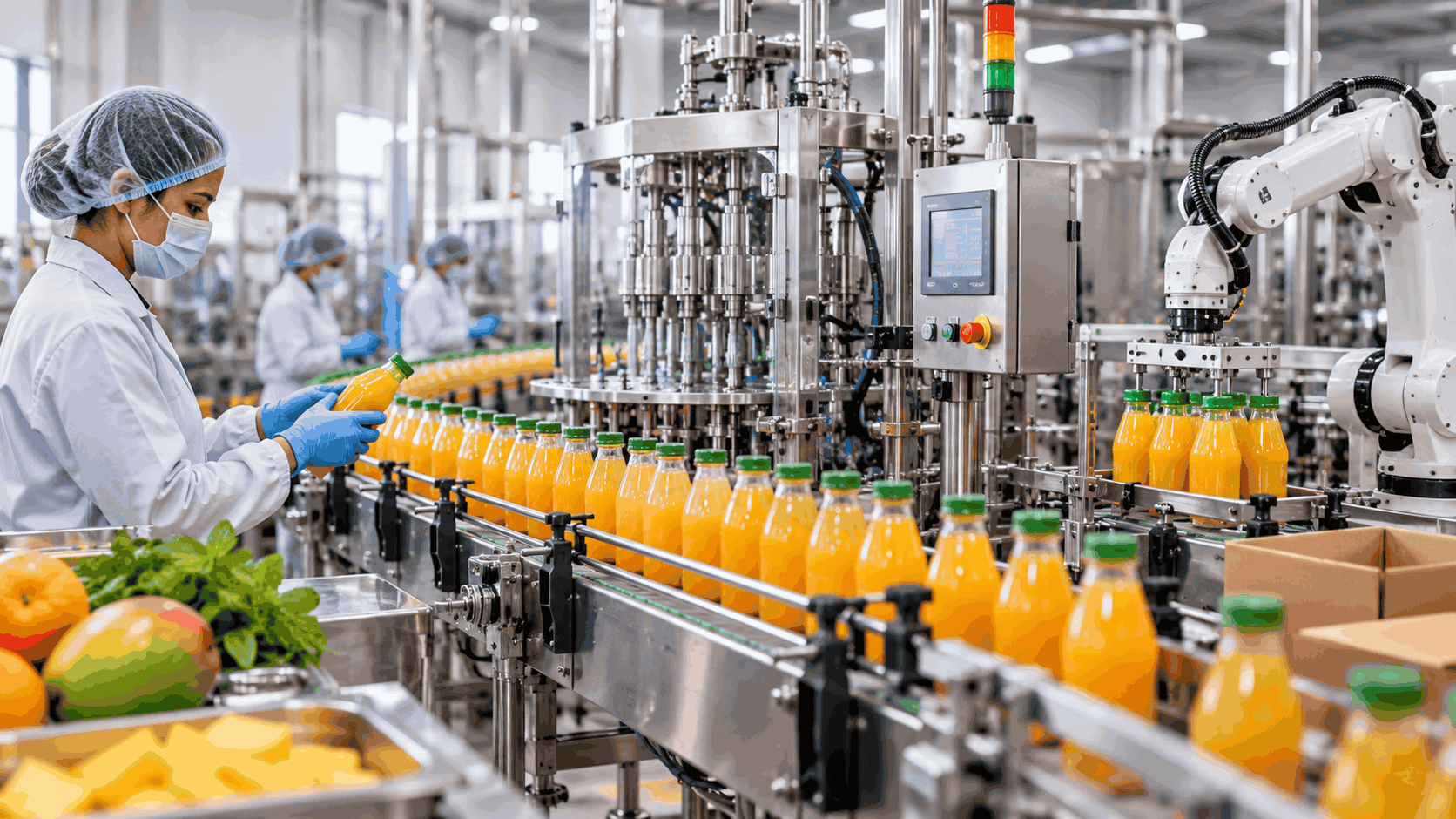
Automated Food Production Lines can improve manufacturing efficiency by coordinating different stages of production through connected machinery and control systems. Depending on the product category, these systems may include automated weighing equipment, temperature sensors, mixing controls, filling machines, inspection technologies, and integrated production software.
When equipment operates in a coordinated manner, manufacturers can reduce unnecessary handling, improve production consistency, and maintain more predictable output. Automation also helps standardise repetitive operations, making it easier to follow approved production procedures. Nevertheless, equipment selection should be based on the product formulation, processing requirements, facility layout, and expected production volume rather than automation alone.
Improving Food Manufacturing Process Optimization
Food Manufacturing Process Optimization focuses on improving how materials, equipment, employees, and production activities work together. Efficient processes help manufacturers reduce waste, avoid bottlenecks, and make better use of available resources. This may involve reorganising production areas, improving material movement, standardising operating procedures, and aligning production schedules with customer demand.
Manufacturers should also evaluate changeover times between product batches, cleaning requirements, and equipment maintenance schedules. Reducing unnecessary delays between production runs can increase available operating time. Clear communication between procurement, production, quality assurance, and dispatch teams further supports a smooth manufacturing workflow.
Using Industrial Automation in Food Processing
Industrial Automation in Food Processing can improve operational control by using programmable equipment, sensors, and monitoring systems to manage critical production parameters. Depending on the application, automated controls can monitor temperature, pressure, processing time, filling volume, and other relevant variables. This helps operators identify deviations and respond before they affect an entire production batch.
Automation is particularly valuable when processes require repeatable operating conditions. However, automated equipment must be correctly configured, regularly maintained, and operated by trained personnel. Manufacturers should establish suitable procedures for calibration, sanitation, equipment inspection, and corrective action to ensure that automation supports both efficiency and food safety.
Adopting Smart Manufacturing in the Food Industry
Smart Manufacturing in the Food Industry combines connected equipment, digital monitoring, production data, and analytical tools to improve operational decisions. These technologies can provide visibility into production performance and help managers identify recurring problems more quickly. Digital dashboards may display information about equipment availability, production output, material usage, downtime, and quality results.
By analysing this information, manufacturers can make informed decisions about production scheduling, maintenance planning, and resource allocation. Digital technologies also enhance product traceability by recording essential manufacturing data, tracking batch details, and maintaining accurate production records throughout the process. Businesses should select technologies that match their operational needs and ensure that collected data is accurate, secure, and useful for decision-making.
Enhancing Food Production Efficiency Through Workforce Training
Although automation can reduce repetitive manual tasks, employees remain essential to efficient food manufacturing operations. Workers need appropriate training to operate machinery, follow hygiene procedures, identify equipment problems, and respond to unexpected production conditions. Without sufficient training, even advanced manufacturing equipment may fail to deliver its expected benefits.
Manufacturers should develop clear standard operating procedures and provide regular training for production, maintenance, and quality assurance teams. Employees should understand their responsibilities, equipment safety requirements, and escalation procedures. Encouraging workers to report inefficiencies and suggest improvements can also help businesses identify practical opportunities to strengthen production performance.
Improving Quality Control Through Automation
Quality Control Automation in Food Processing helps manufacturers monitor product characteristics and identify deviations during production. Depending on the application, automated inspection technologies can assess fill levels, package integrity, product appearance, weight, and other measurable quality parameters. Process sensors can also help monitor critical conditions that influence product consistency and safety.
Automated inspection should complement, rather than replace, appropriate quality management practices. Manufacturers must establish suitable acceptance criteria, verify inspection equipment, maintain accurate records, and investigate quality deviations. A well-designed quality system helps reduce avoidable rework, product losses, and customer complaints while supporting consistent manufacturing standards.
Optimising Automated Food Packaging Systems
Packaging is an important stage in food manufacturing because it affects production speed, product protection, shelf-life performance, and presentation. Automated Food Packaging Systems can support filling, sealing, labelling, coding, and packing activities while reducing repetitive manual handling. When properly integrated with upstream production equipment, packaging systems can help prevent bottlenecks and maintain a consistent flow of finished products.
Manufacturers should choose packaging equipment according to the product type, packaging material, container format, required output, and applicable food safety requirements. Regular inspection of seals, labels, batch codes, and package integrity remains essential. Packaging automation should be evaluated alongside material costs, changeover requirements, maintenance needs, and the risk of production interruptions.
Exploring Robotics in Food Manufacturing
Robotics in Food Manufacturing can improve productivity in suitable applications involving repetitive movements, product handling, sorting, palletising, and packaging. Robotic systems may help reduce manual handling demands, improve operational consistency, and support safer working conditions when designed and implemented appropriately.
Before investing in robotics, manufacturers should consider product variability, available workspace, equipment compatibility, cleaning requirements, and employee safety. A detailed feasibility assessment can help determine whether robotic systems offer sufficient operational benefits. In many facilities, targeted automation of a specific task may deliver greater value than replacing an entire production process.
Managing Equipment Maintenance and Downtime
Unplanned equipment downtime can interrupt production schedules, delay deliveries, and increase operating costs. Preventive maintenance helps manufacturers identify wear, replace components when necessary, and maintain equipment in suitable operating condition. Maintenance schedules should reflect manufacturer recommendations, equipment usage, operating conditions, and previous failure patterns.
Where appropriate, condition-monitoring technologies can help identify unusual equipment behaviour before a major failure occurs. Manufacturers should maintain maintenance records, keep essential spare parts available, and train operators to recognise early warning signs. Combining preventive maintenance with reliable production planning helps reduce interruptions and improve the overall utilisation of manufacturing assets.
Supporting Production Scalability in the Food Industry
Production Scalability in the Food Industry requires manufacturing systems that can accommodate changes in demand without compromising quality or operational control. Businesses experiencing growth should assess whether their existing equipment, workforce, storage capacity, utilities, and packaging operations can support higher output.
Scaling Food Manufacturing Operations may involve upgrading selected machines, introducing additional shifts, improving production scheduling, or investing in integrated automation. Manufacturers should forecast demand carefully and compare the cost of expanding existing capacity with the cost of establishing additional production infrastructure.
Companies looking to concentrate on product innovation, brand building, and market expansion can consider outsourcing production to reliable third-party manufacturers. For example, EXIITO's contract manufacturing services provide a way for businesses to discuss production requirements, specifications, volumes, quality expectations, and agreed manufacturing arrangements without necessarily building their own factory.
Reducing Costs Through Better Manufacturing Decisions
Cost Reduction in Food Manufacturing depends on controlling material losses, energy consumption, labour requirements, equipment downtime, and unnecessary production activities. Automation can contribute to these improvements, but the benefits depend on the suitability of the technology and how effectively it is managed.
Manufacturers should evaluate the total cost of ownership before purchasing new equipment. This includes installation, employee training, maintenance, energy consumption, software, spare parts, and potential production interruptions. Measuring the return on investment against clearly defined operational targets helps businesses distinguish meaningful improvements from unnecessary capital expenditure.
Inventory management is equally important. Keeping inventory at optimal levels helps prevent production disruptions, minimize raw material waste and spoilage, and control unnecessary warehousing expenses. Accurate demand forecasting and coordination between purchasing and production teams can improve material availability while reducing avoidable waste.
Understanding Food Manufacturing Technology and Digital Transformation
Food Manufacturing Technology continues to evolve through improved automation, connected sensors, production analytics, and integrated business systems. Digital Transformation in Food Manufacturing allows businesses to connect production information with inventory, procurement, quality assurance, and order management activities.
When implemented effectively, integrated systems can improve planning accuracy, support traceability, and help managers identify performance issues across departments. Manufacturers should introduce digital technologies gradually, prioritising systems that address their most important operational challenges. Clear implementation plans, employee training, data accuracy, and ongoing performance reviews are necessary to achieve sustainable benefits.
Businesses evaluating external production partnerships can also review EXIITO's manufacturing capabilities to understand its manufacturing categories and available partnership models. The appropriate arrangement depends on product requirements, production volumes, packaging needs, and confirmed operational capabilities.
Measuring and Monitoring Manufacturing Performance
Continuous improvement requires manufacturers to measure whether operational changes are delivering the intended results. Useful performance indicators include production output, equipment downtime, rejection rates, material waste, energy consumption, order fulfilment time, and overall equipment effectiveness. These measurements help identify trends and provide a practical basis for comparing performance over time.
Manufacturers should establish realistic targets and review performance regularly. When results fall below expectations, teams should investigate the underlying causes rather than focusing only on short-term output. A structured improvement process helps businesses correct recurring problems, refine operating procedures, and maintain consistent progress.
Conclusion n
Improving efficiency in food processing plants requires a balanced approach that combines suitable automation, effective production planning, employee training, preventive maintenance, quality control, and continuous performance monitoring. Food Manufacturing Automation can help businesses improve consistency, reduce waste, manage operating costs, and prepare for increasing production demand when implemented according to their actual requirements.
Manufacturers should begin by identifying operational bottlenecks, measuring current performance, and prioritising improvements that offer clear business value. As production requirements evolve, regular evaluation of equipment, digital systems, and manufacturing workflows can support sustainable growth.
For businesses seeking manufacturing partnerships, EXIITO offers information about its contract manufacturing solutions, private label manufacturing services, and broader manufacturing services. Visit the relevant pages to explore available options and contact the company to discuss your specific requirements.